

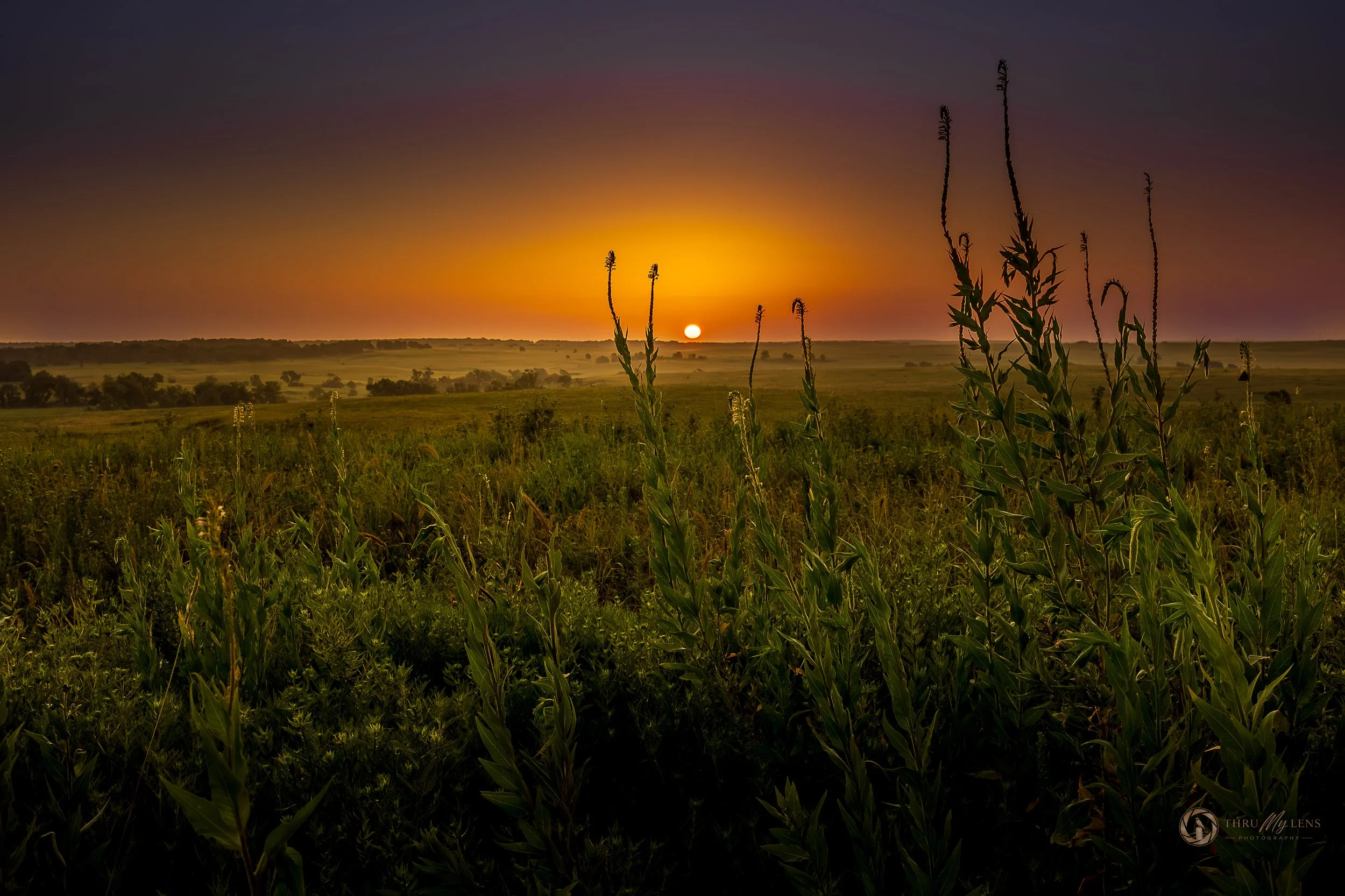
Sunrise's Quiet Promise
As dawn breaks over the Tallgrass Prairie Preserve near Pawhuska, Oklahoma, the prairie awakens with golden light, birdsong, and moving bison. Discover why sunrise remains one of nature's most reassuring daily miracles.
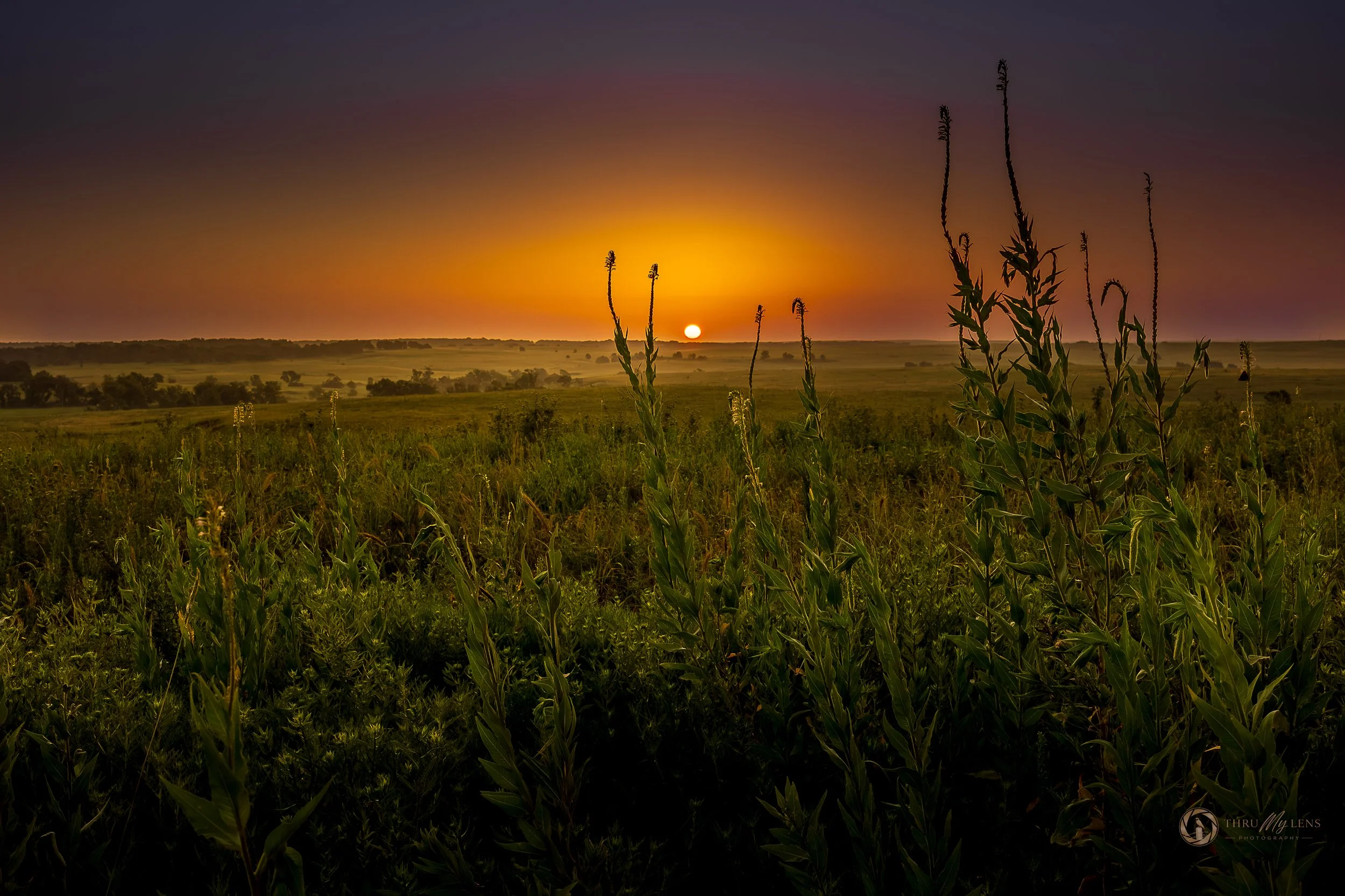
There is something special about sunrise.
Night slowly surrenders to the morning light. Deep blues and purples begin to warm beneath golden rays as the sky quietly announces a new day. The change is almost imperceptible at first. Faint traces of light appear low on the horizon, yet the entire sky hints that something beautiful is about to happen—if we simply take the time to look.
As the sun peeks above the broad prairie, dew-covered grasses catch the first light and sparkle like countless tiny mirrors. The sounds of the night begin to fade. Owls and whip-poor-wills give way to the songs of meadowlarks and robins. Across the rolling hills, the bison begin to move through the same ancient grasslands their ancestors have crossed for centuries.
Even the air feels different. For a brief moment it seems cooler, almost as though it is gathering itself before surrendering to the heat of a summer day.
Then, almost without warning, the soft glow of dawn gives way to the full brilliance of daylight. Sunrise is over before you realize it.
Yet there is comfort in knowing it will happen again.
In a few short hours, daylight will quietly surrender to evening. Darkness will return, the stars will reclaim the sky, and somewhere beyond the horizon another sunrise will already be preparing for tomorrow.
There is something deeply reassuring about that rhythm.
The world continues its faithful cycle, reminding us that every ending carries the promise of another beginning. Perhaps that is why sunrise has always felt less like the start of another day and more like a quiet reminder that hope arrives one dawn at a time.
The steadfast love of the Lord never ceases; his mercies never come to an end; they are new every morning; great is your faithfulness. Lamentations 3:22-23
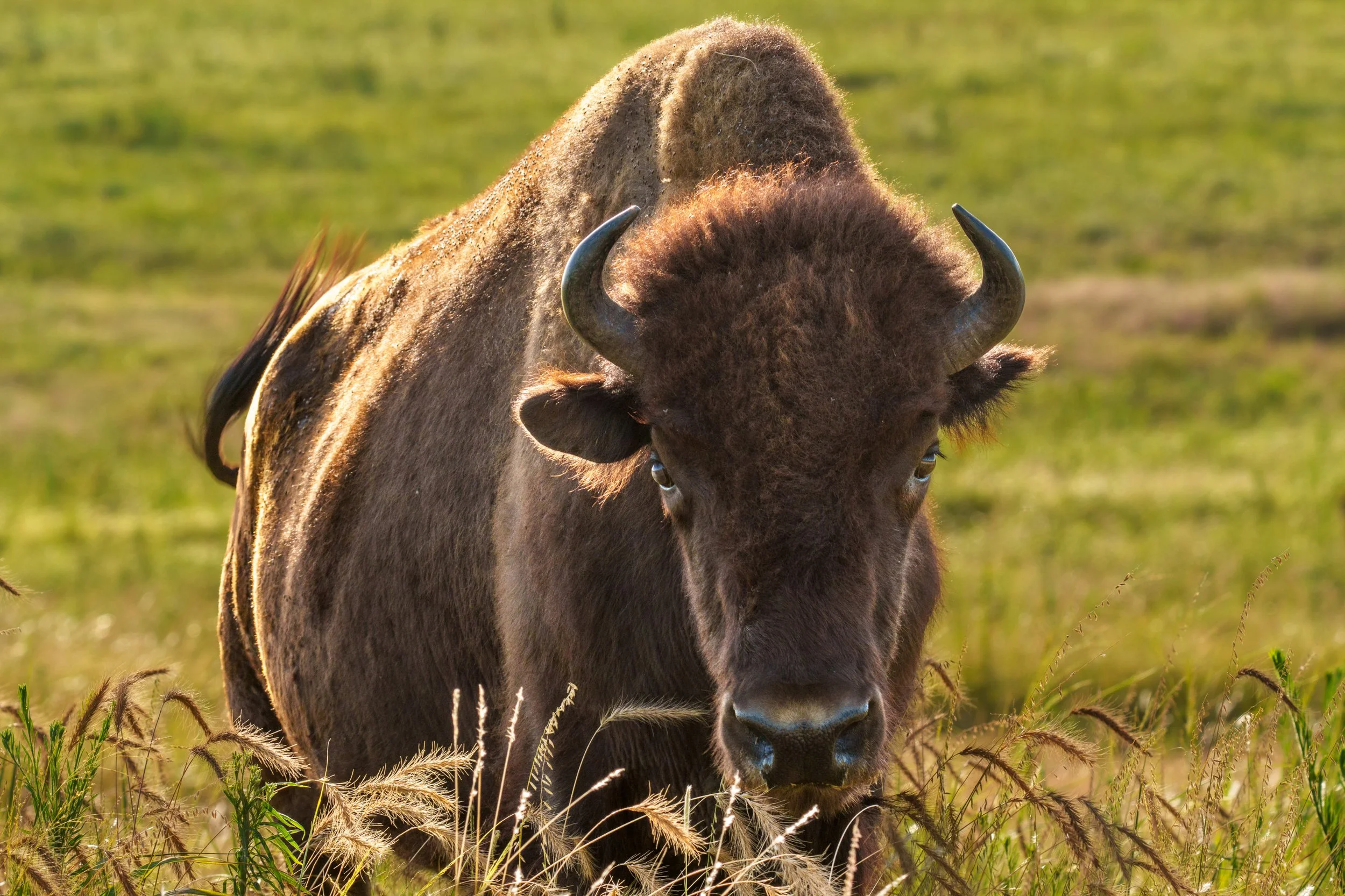
When the Bison Came to My Window
Follow a wildlife photography adventure at Oklahoma's Tallgrass Prairie Preserve, where an unforgettable encounter with a curious bison became a lesson in respecting wild nature.
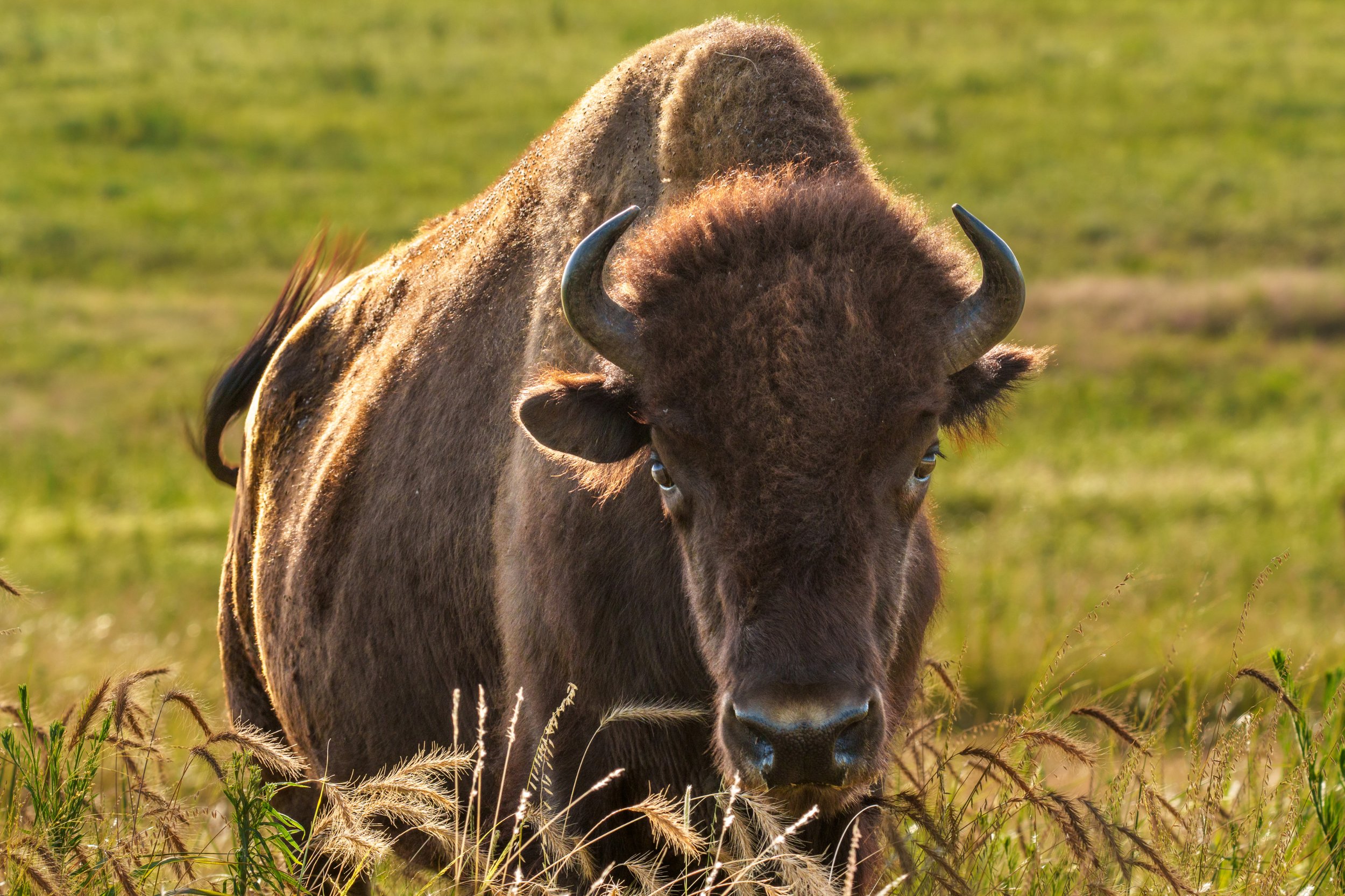
Joseph H. Williams Tallgrass Prairie Preserve – Pawhuska, Oklahoma
There are few places left in America where you can watch bison roam across an open prairie much as they did centuries ago. The Joseph H. Williams Tallgrass Prairie Preserve is one of those rare places. More than 40,000 acres of rolling grassland provide a home for one of the nation's largest free-ranging bison herds, and it is a photographer's dream.
Watching them from a distance, it's easy to underestimate these magnificent animals.
An adult bull can weigh as much as 2,500 pounds. Despite their size, bison can run nearly 35 miles per hour, maintain that speed for surprising distances, and even leap six feet into the air. They are incredibly agile, powerful...and wonderfully unpredictable.
That's why I almost always photograph wildlife from inside my vehicle.
Many wild animals pay little attention to a parked car. By using my vehicle as a photography blind, I can observe natural behavior without causing unnecessary stress or altering the animals' routines. It's one of the simplest and most ethical ways to photograph wildlife.
At least...that's usually how it works.
On this particular morning, I was filming a herd of more than fifty bison as they slowly crossed the prairie in front of me. My camera rested on the window, quietly recording as they passed one by one.
Then one of them stopped.
She turned.
And began walking directly toward my car.
As she drew closer, I decided it was probably wise to pull my camera back inside. Moments later, the camera lens was replaced by something considerably larger—her enormous nose.
She gently pushed her muzzle through my open window.
I'll admit, my heart rate increased a bit.
Not quite knowing what else to do, I cautiously scratched her nose and under her chin.
To my amazement, she closed her eyes.
Then came a deep, contented moan.
For several unforgettable seconds, this massive wild animal simply enjoyed the attention before pulling away, rejoining the herd, and disappearing into the sea of tallgrass as though nothing unusual had happened.
It was exhilarating.
It was a little unnerving.
And it was a reminder that wildlife is never completely predictable.
Experiences like this are exactly why I love spending time in wild places. Nature continually reminds us that these animals are not attractions or oversized pets. They deserve our admiration, our respect, and enough space to simply be wild.
Sometimes that respect means staying behind a camera lens.
And every once in a while...
it means finding yourself nose-to-nose with a bison.
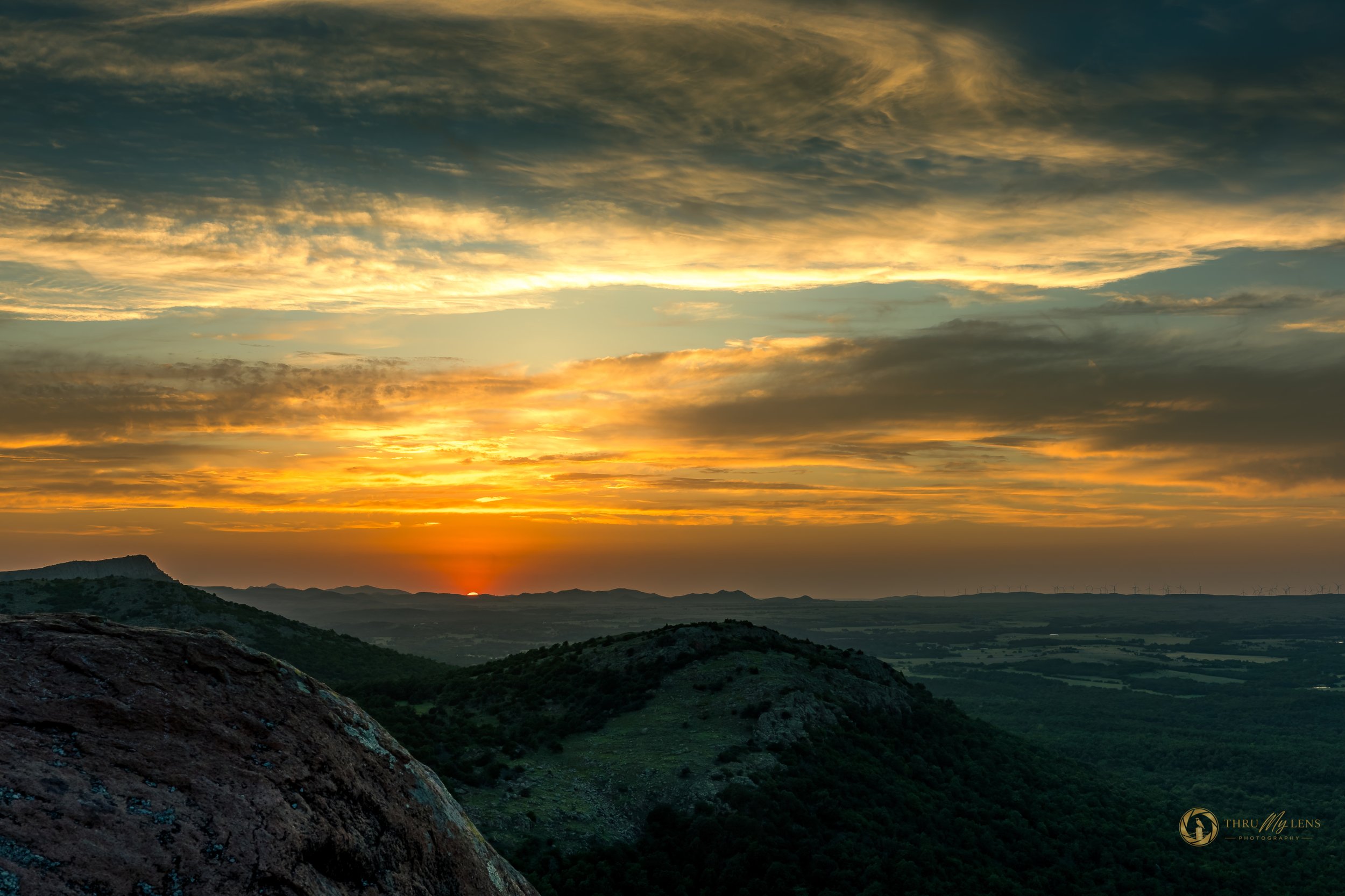
A Mountain’s Farewell
As the sun sets over Mount Scott, the Wichita Mountains reveal one final masterpiece. Join me for an evening above ancient granite peaks, where golden skies, deepening shadows, and quiet reflection bring a memorable Oklahoma adventure to a close before the journey continues to the Joseph H. Williams Tallgrass Prairie Preserve.
Sunset from Mount Scott in the Wichita Mountains of Oklahoma
Some places ask you to linger just a little longer.
After days spent wandering among ancient granite peaks, watching bison graze the valleys, photographing prairie dogs, and exploring the remarkable story of the Holy City of the Wichitas, there seemed only one fitting way to end my visit—by climbing to the summit of Mount Scott to watch the sun disappear beyond the western horizon.
It was worth every mile.
The granite beneath my feet still held the warmth of another Oklahoma summer day as the light slowly softened across the landscape. The valleys below began disappearing into shadow while the western sky caught fire with layers of gold, amber, and crimson. Behind me, the mountain itself transformed as long shadows climbed its weathered granite face, revealing textures that had been hidden in the bright afternoon sun.
Standing there, I was reminded that sunsets rarely demand attention through spectacle alone. Often their beauty comes through contrast—the fading light against the growing darkness, the brilliance of the sky against the quiet strength of the earth below.
The Wichita Mountains have stood through countless sunsets like this one. Long before roads wound their way to Mount Scott and visitors gathered at overlooks, these ancient granite mountains watched the sun sink below the prairie every evening. They remain a quiet testimony to both the permanence of creation and the passing nature of our own moments within it.
As photographers, we often chase dramatic light, hoping for that perfect image. But evenings like this remind me that the greater gift isn't simply the photograph I bring home. It is the privilege of standing still long enough to witness beauty unfolding before me.
With the last glow fading from the horizon, it felt like the mountains were offering a quiet farewell. My time among the bison, rugged peaks, and historic landmarks had come to an end, but another adventure was already waiting.
The journey now turns north and east, across Oklahoma and into Kansas, where an entirely different landscape awaits. From granite mountains to rolling seas of native grass, my next destination is the Joseph H. Williams Tallgrass Prairie Preserve—a place where the horizon stretches endlessly, the prairie wind tells its own story, and another chapter of God's remarkable creation is ready to be explored.
Every landscape has a voice.
The Wichita Mountains spoke through stone.
The prairie, I suspect, will speak through the wind.
— Dan Nobles
Thru My Lens Photography
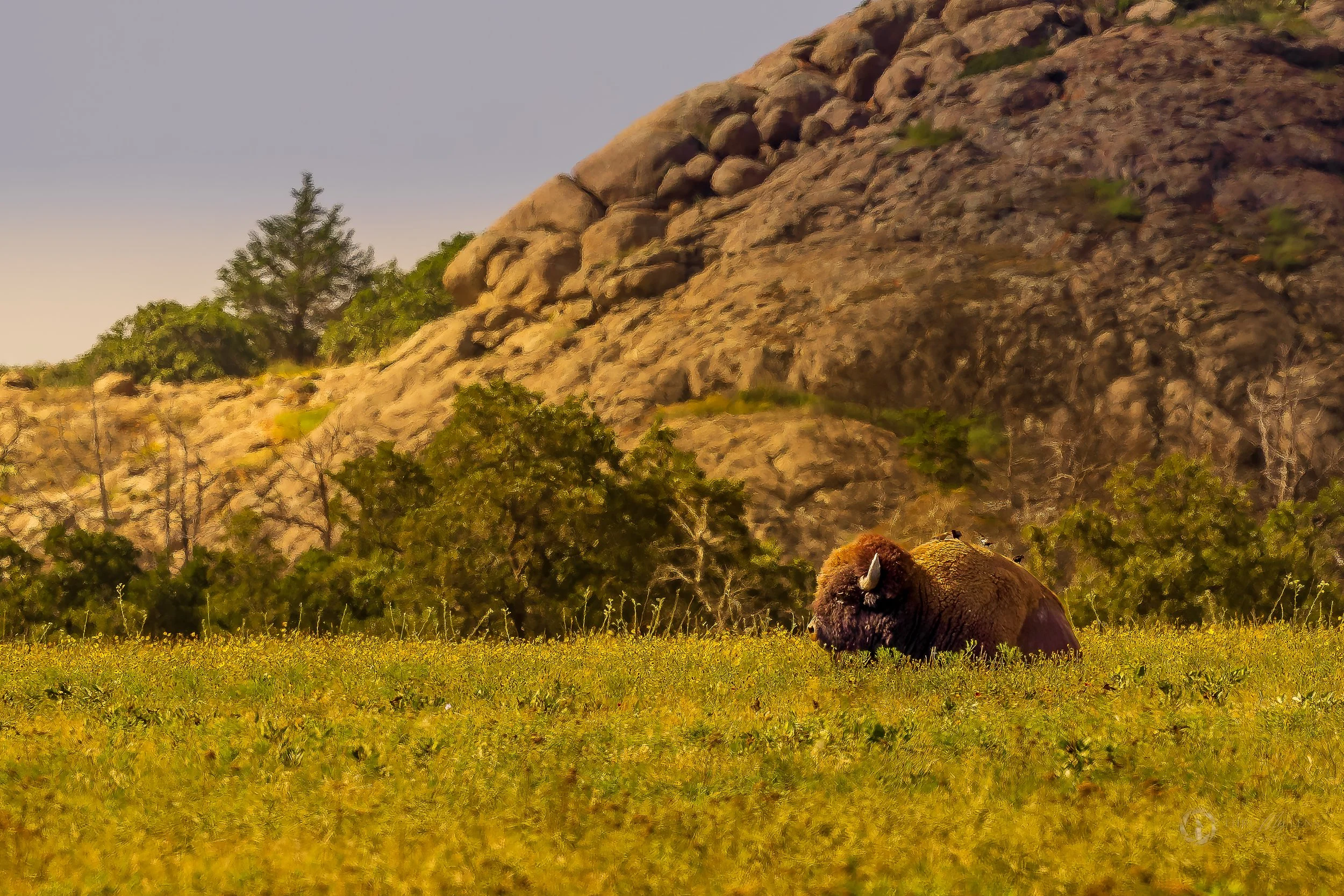
Quiet Confidence in the Evening Light
After spending the day beneath the Oklahoma sun, this old bull settled into a field at the foot of the Wichita Mountains. As the evening cooled, a gentle breeze drifted through the valley, carrying with it the quiet promise that another day was coming to an end.
Bison rests in the open valley at Wichita Mountains Wildlife Refuge, Oklahoma
There is something deeply satisfying about watching a bison at rest.
After spending the day beneath the Oklahoma sun, this old bull settled into a field at the foot of the Wichita Mountains. As the evening cooled, a gentle breeze drifted through the valley, carrying with it the quiet promise that another day was coming to an end.
He wasn't searching.
He wasn't competing.
He wasn't anxious.
He simply rested.
Standing there with my camera, I found myself lingering far longer than I had planned. In a world that constantly urges us to do more, become more, and hurry to whatever comes next, this massive animal offered a very different lesson.
Strength doesn't always announce itself.
Sometimes it lies quietly in the grass.
The American bison has endured nearly unimaginable hardship. Once numbering in the tens of millions across North America, they were driven to the edge of extinction during the nineteenth century. Yet today, protected places like the Wichita Mountains Wildlife Refuge remind us that restoration is possible. Their presence is more than a conservation success story—it is a symbol of resilience.
Perhaps that is why this scene spoke to me.
Freedom is often misunderstood. We imagine it as endless movement, constant adventure, or the absence of responsibility. Yet the bull before me suggested something altogether different.
True freedom is the ability to rest without fear.
To be fully present.
To exist without needing to prove anything.
There was no audience for this moment except the evening sky, the weathered granite behind him, and one photographer fortunate enough to witness it.
Nature has a remarkable way of slowing our pace. It reminds us that not every moment needs to be productive. Some moments are meant simply to be experienced.
As the sun dipped lower behind the mountains, I quietly packed my camera and left the valley exactly as I had found it.
The bison never moved.
He didn't need to.
He had already shown me everything I came to see.
"Come to me, all who labor and are heavy laden, and I will give you rest." — Matthew 11:28
Perhaps that is one of creation's quiet invitations. In places where the wind moves through prairie grass and ancient mountains stand watch, we are reminded that rest is not weakness. It is often the evidence of trust.
Until next time, may you find moments to slow down, breathe deeply, and discover the quiet confidence that only nature can teach.
See you down the trail... and now, thru my lens.
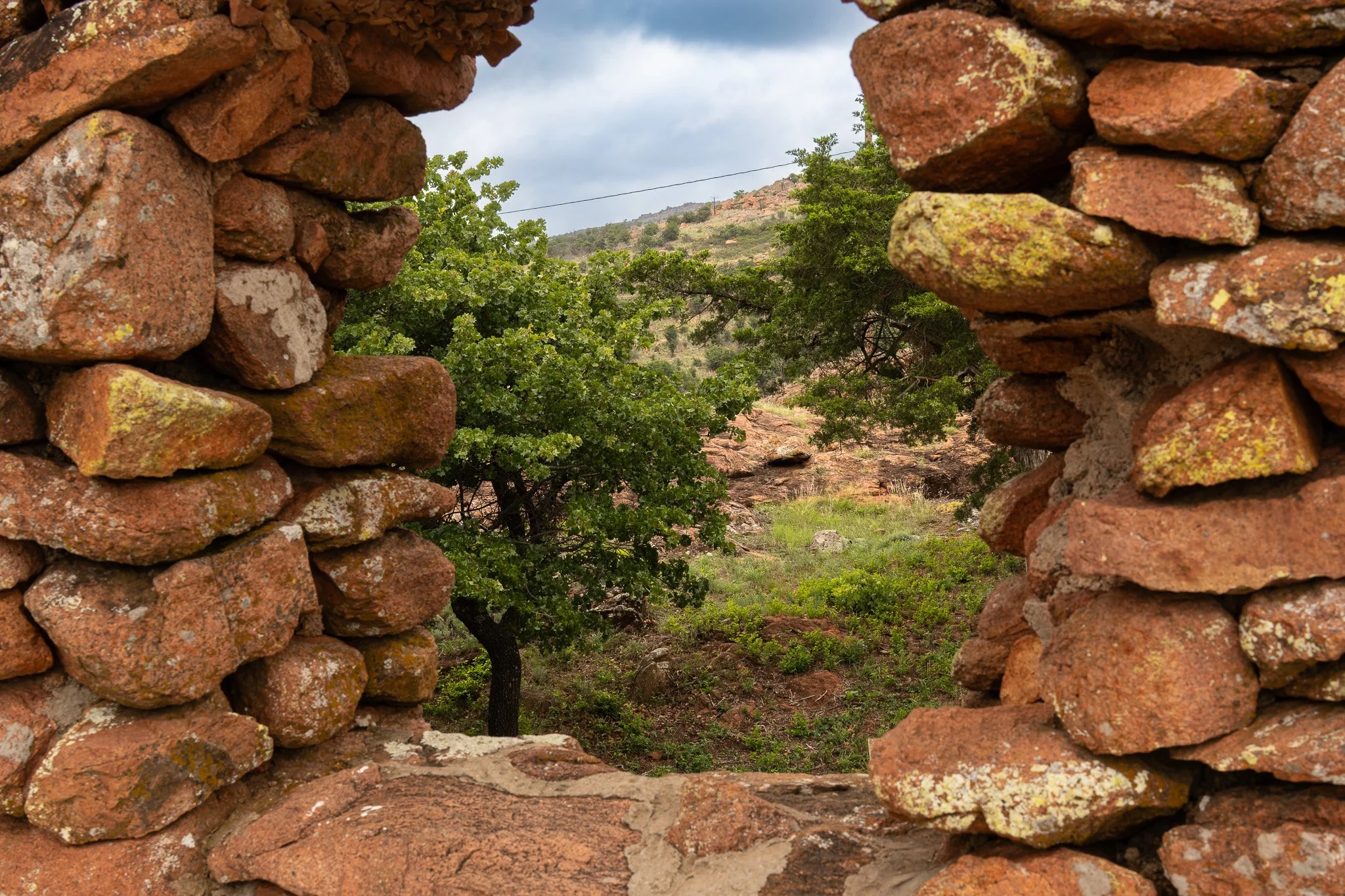
Looking Through the Window of Time
The Holy City of the Wichitas is Nestled against the rugged granite slopes of Oklahoma's Wichita Mountains, these weathered stone structures have stood for nearly a century. Built during the Great Depression by the Civilian Conservation Corps and the Works Progress Administration.
Holy City of the Wichitas | Wichita Mountains, Oklahoma
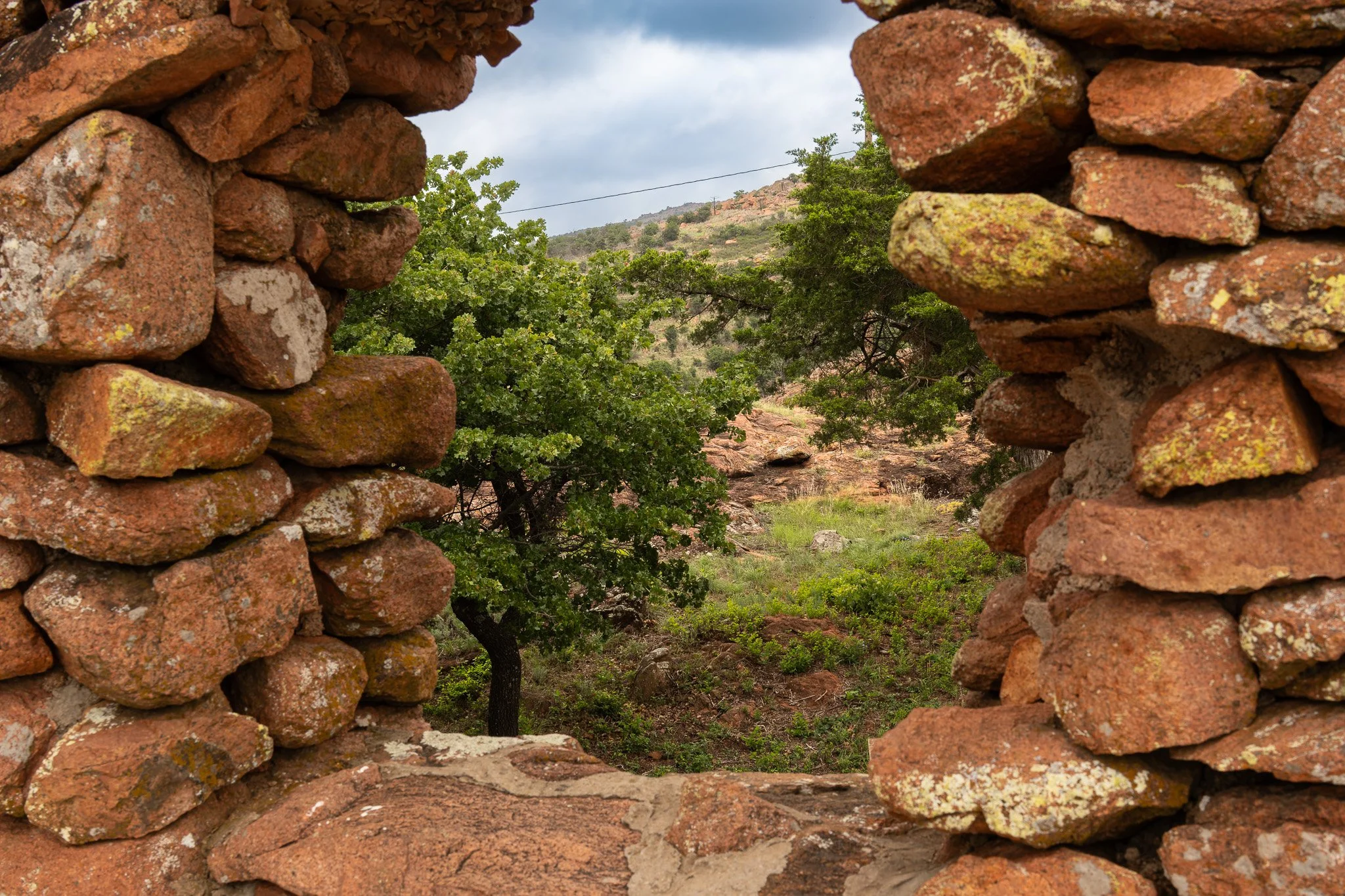
View through the wall of the Holy City of the Wichitas
There are places that ask to be photographed.
Then there are places that ask you to stop, stand quietly, and simply look.
The Holy City of the Wichitas is one of those places.
Nestled against the rugged granite slopes of Oklahoma's Wichita Mountains, the weathered stone structures have stood for nearly a century. Built during the Great Depression by the Civilian Conservation Corps and the Works Progress Administration, the site was created as the backdrop for an annual Easter Passion Play. Today, its stone walls and narrow passageways remain long after the crowds have gone home, quietly blending into the landscape that surrounds them.
As I wandered through the empty courtyards, I wasn't searching for a specific photograph. I was simply exploring.
Then I noticed one of the small stone openings in the wall.
Instead of photographing the building itself, I stepped closer and looked through the opening. Suddenly, the landscape beyond became the subject. The rough granite stones framed a living scene of cedar trees, native grasses, and distant hills gathering beneath darkening clouds.
It felt less like looking through a window and more like looking through time.
The stone walls represent human hands—our desire to build, preserve, and remember.
Beyond the opening stands a landscape that has changed very little over countless generations. Long before these stones were stacked together, bison wandered these valleys, Native American tribes called these mountains home, and the granite cliffs quietly watched the passing centuries.
The photograph became more than an image of a historic structure.
It became a reminder that while our works eventually weather and fade, creation continues to tell its story.
As photographers, we're often tempted to focus on the obvious subject. Sometimes the better image is found by changing our perspective. Instead of looking at something, we learn to look through it.
That small opening in the wall became a frame—not only for the landscape but for a different way of seeing.
One of the greatest gifts photography has given me is the ability to slow down. The camera has taught me that beauty rarely announces itself. It waits patiently for those willing to pause, observe, and notice.
This photograph is a reminder that every journey offers more than a destination. Sometimes the most meaningful discoveries come when we stop looking for the grand vista and begin paying attention to the quiet details along the way.
Over the next four weeks, I'll be sharing photographs and stories from my journey through the Wichita Mountains—rugged landscapes, incredible wildlife, historic places, and unforgettable moments beneath Oklahoma skies. I hope you'll come along.
Through My Lens
As I stood behind that weathered stone wall, I couldn't help but think of the words of the psalmist:
"The heavens declare the glory of God, and the sky above proclaims his handiwork." — Psalm 19:1 (ESV)
Sometimes God's handiwork is revealed in sweeping mountain vistas.
Sometimes it is found through a small opening in an old stone wall.
Either way, the invitation is the same:
Slow down.
Look carefully.
Wonder.
Because the world has far more to say than we often take the time to hear.
Every photograph tells a story.
Some reveal breathtaking landscapes. Others capture fleeting moments in the lives of wild creatures. All of them invite us to slow down, look closer, and rediscover the wonder woven throughout God's creation.
Thanks for joining me on the journey.
I'll see you down the next backroad.
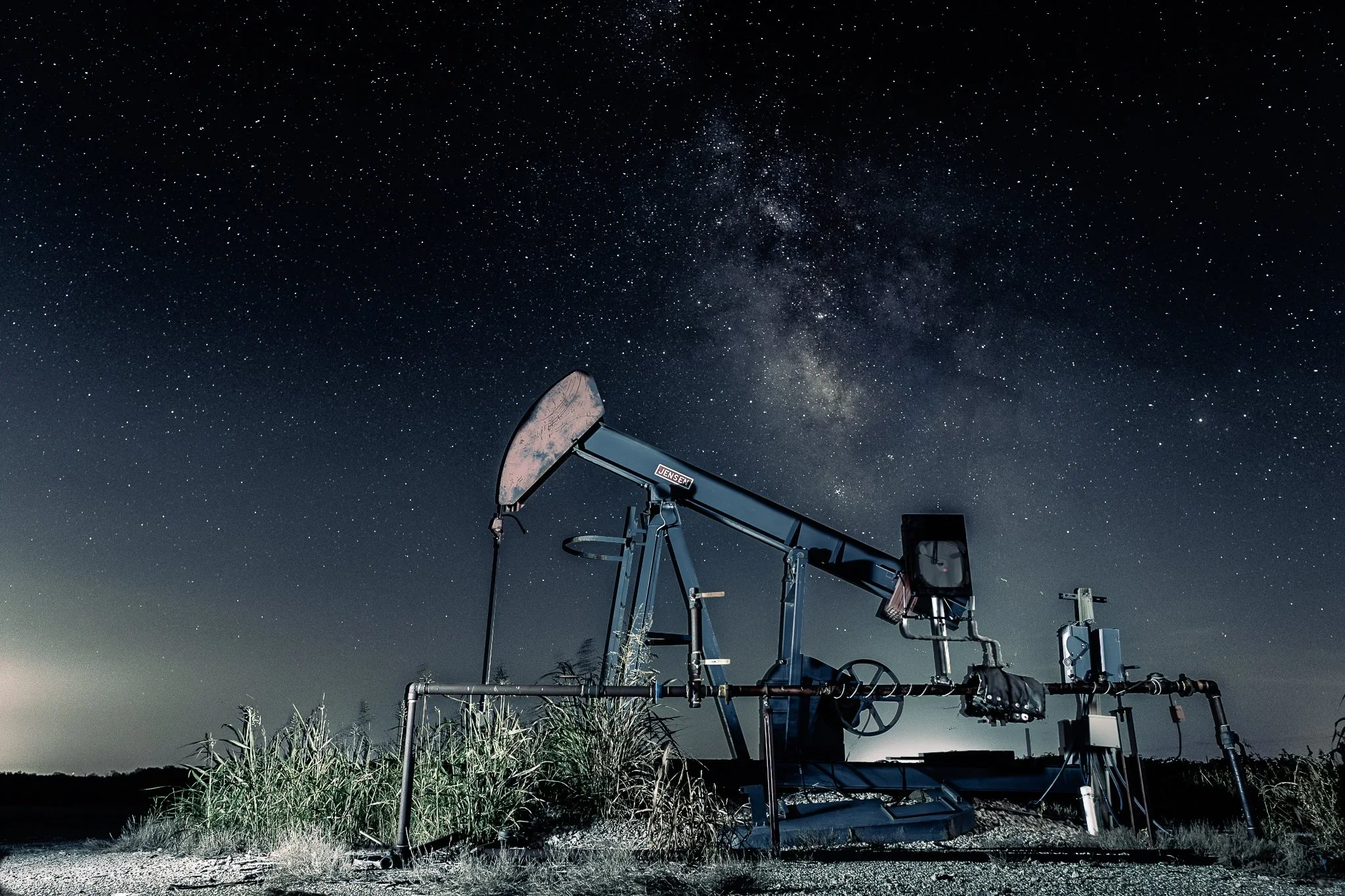
The Machinery Beneath the Stars
An aging oil pump works quietly beneath the Kansas night while the Milky Way rises overhead. In a single frame, industry meets eternity, reminding us that some of life's greatest lessons come when we pause long enough to look up.
Kansas has a way of revealing its character after dark
During the day, the wheat fields stretch toward the horizon beneath an endless sky, and the rhythmic nod of oil pumps blends into the landscape as naturally as windmills and grain elevators. They are part of the working heart of the prairie—quiet reminders that beneath the fertile soil lies another resource that has helped shape the history and economy of the region.
On this particular night, I found myself sitting alone in a wheat field, camera pointed toward an aging oil pump silhouetted against a crystal-clear sky. The air was still. Not a breeze stirred the wheat. The usual sounds of the prairie seemed muted, as if the land itself was holding its breath.
As darkness deepened, the stars emerged one by one until the heavens were crowded with light. Then came the moment I had been waiting for. Rising slowly from the shoulder of the pump jack, the Milky Way climbed into view—a luminous river of distant suns and galaxies stretching across the sky.
The contrast was striking.
Before me stood a machine built by human hands, designed to draw resources from deep beneath the earth. Above it stretched a cosmos so vast that the mind struggles to comprehend it. One represented industry, ingenuity, and progress. The other represented mystery, eternity, and wonder.
Yet they seemed perfectly at home together.
The oil pump moved steadily through its endless cycle, drawing from unseen depths below while the galaxy arched overhead, revealing unimaginable depths above. In that moment, the scene felt like a visual bridge between two worlds—the practical and the profound, the temporal and the timeless.
Photography often begins with finding interesting light, but sometimes it becomes something more. Sometimes a photograph becomes an invitation to simply sit and witness. No rushing. No agenda. Just presence.
The experience was breathtaking not because it was dramatic or loud, but because it was so quietly magnificent. Beneath billions of stars, surrounded by open prairie, I was reminded how small we are—and how fortunate we are to experience moments like these at all.
Monk Reflection
We spend much of our lives digging downward.
We search for success, security, answers, and purpose. Like the oil pump reaching deep beneath the Kansas soil, we labor to uncover things we believe will sustain us. There is value in that work. It provides, strengthens, and teaches us perseverance.
But every so often, life invites us to look up.
The stars remind us that there is more to existence than what we can produce, accumulate, or control. Beyond our daily pursuits lies a universe of beauty, mystery, and grace that asks nothing of us except our attention.
Wisdom is found in holding both truths together.
Keep doing the work before you. Draw from the depths of your experience, your faith, and your character. But don't become so focused on what lies beneath your feet that you forget to lift your eyes to the heavens.
Sometimes the richest discoveries are not found by digging deeper, but by looking higher.
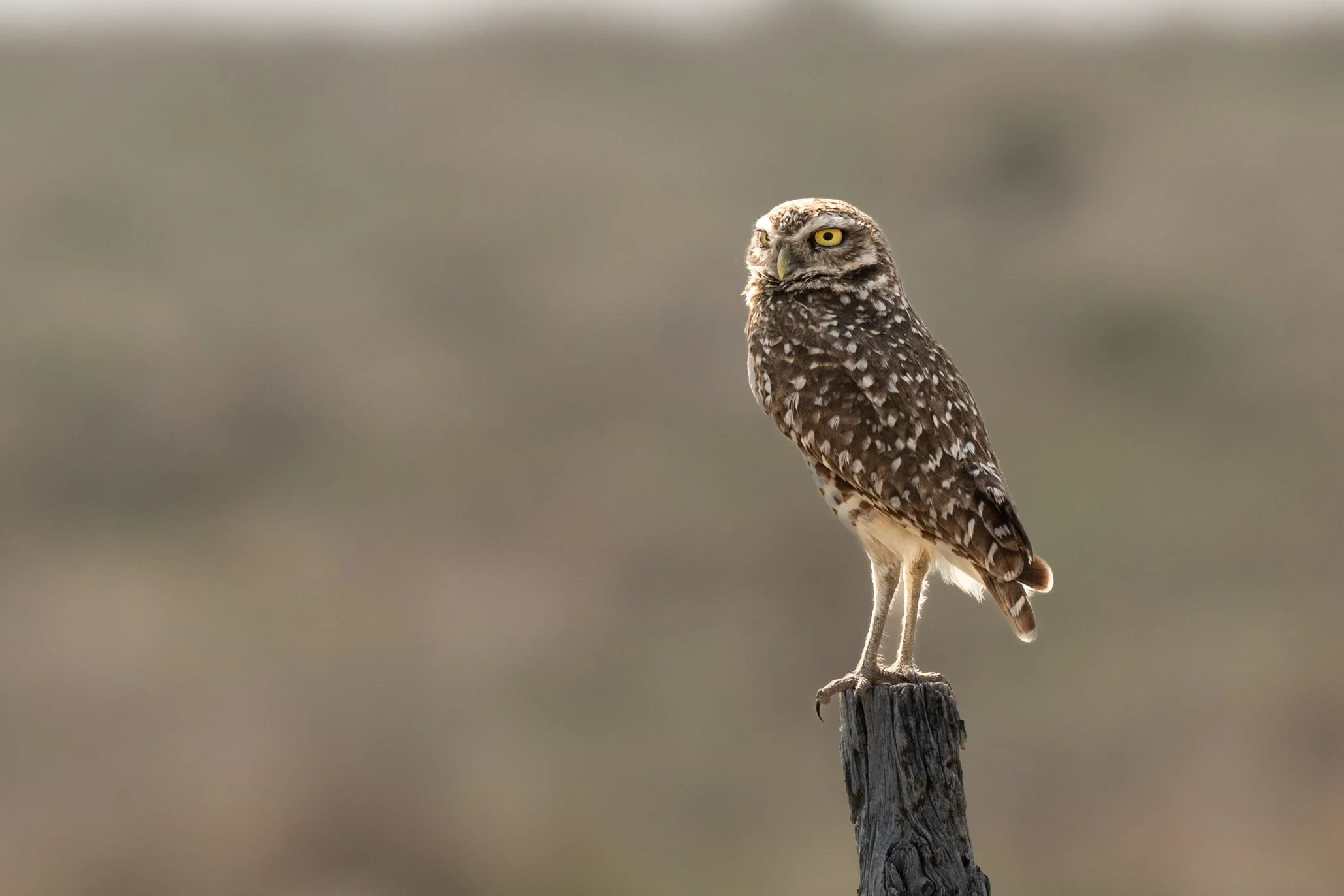
The Quiet Watcher of Gove County
On a lonely back road in western Kansas, a burrowing owl perched quietly on an old fence post became an unforgettable reminder of the stillness and beauty hidden within the prairie landscape.
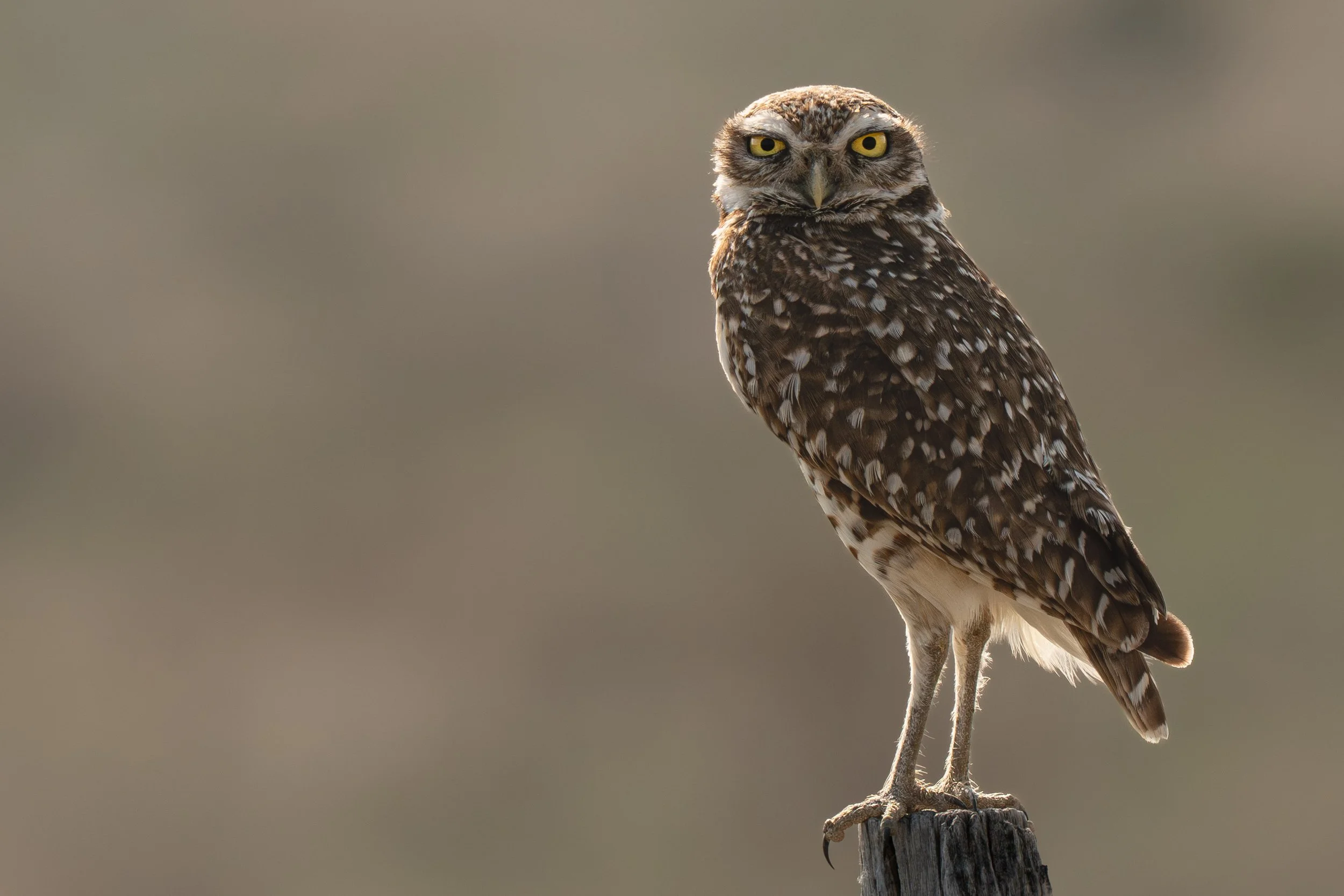
A Burrowing Owl sits alone
There are places in western Kansas where the horizon feels endless and the roads seem to disappear into another time. On this particular afternoon in Gove County, I had driven mile after mile along a lonely gravel road, dust rolling behind my CR-V like a prairie storm. No traffic. No noise. Just the hum of tires on limestone and the open silence of the plains.
Then I noticed him.
Perched on an old weathered fence post beside the road was a burrowing owl — small, upright, and impossibly alert. At first glance he almost looked misplaced, like a forgotten ornament standing against the muted earth tones of the prairie. But those bright yellow eyes gave him away immediately. I slowed the car and carefully rolled alongside him, staying inside the vehicle and using it as a blind. Resting my 600mm lens on the open window, I began photographing one of the most fascinating birds of the Great Plains.
What surprised me most was his calmness.
He never startled. Never flushed. For nearly an hour, it felt as though we simply shared the same stretch of quiet Kansas earth together. Out there, with no passing vehicles and no distractions, time slowed to the rhythm of the prairie wind. The owl would occasionally tilt his head, scanning the grasslands with patient precision, then settle again into stillness. It was one of those rare wildlife encounters that cannot be forced or manufactured. It simply becomes a gift.
Burrowing owls are wonderfully unique creatures. Unlike most owls, they spend much of their lives on the ground, nesting in abandoned prairie dog burrows and hunting insects and small prey across open country. Their long legs and upright posture often make them appear more curious than intimidating. Yet they are perfectly designed for this harsh and beautiful landscape.
As I sat there alone with this feathered companion, I realized how few places remain where silence still feels untouched. Places where wildlife can exist without hurry and where a person can sit long enough to truly notice the details — the texture of feathers, the movement of wind through grass, the golden light reflecting in an owl’s eyes.
Moments like this are why I keep returning to the back roads.
Not simply to photograph wildlife, but to experience the stillness that comes with it.
Monk Reflection
The prairie rarely shouts for attention. Its beauty is quiet, patient, and easily overlooked by those rushing through it. Yet when we slow down long enough to truly see, even a small owl on a weathered fence post can remind us how much wonder still exists in the ordinary corners of creation.
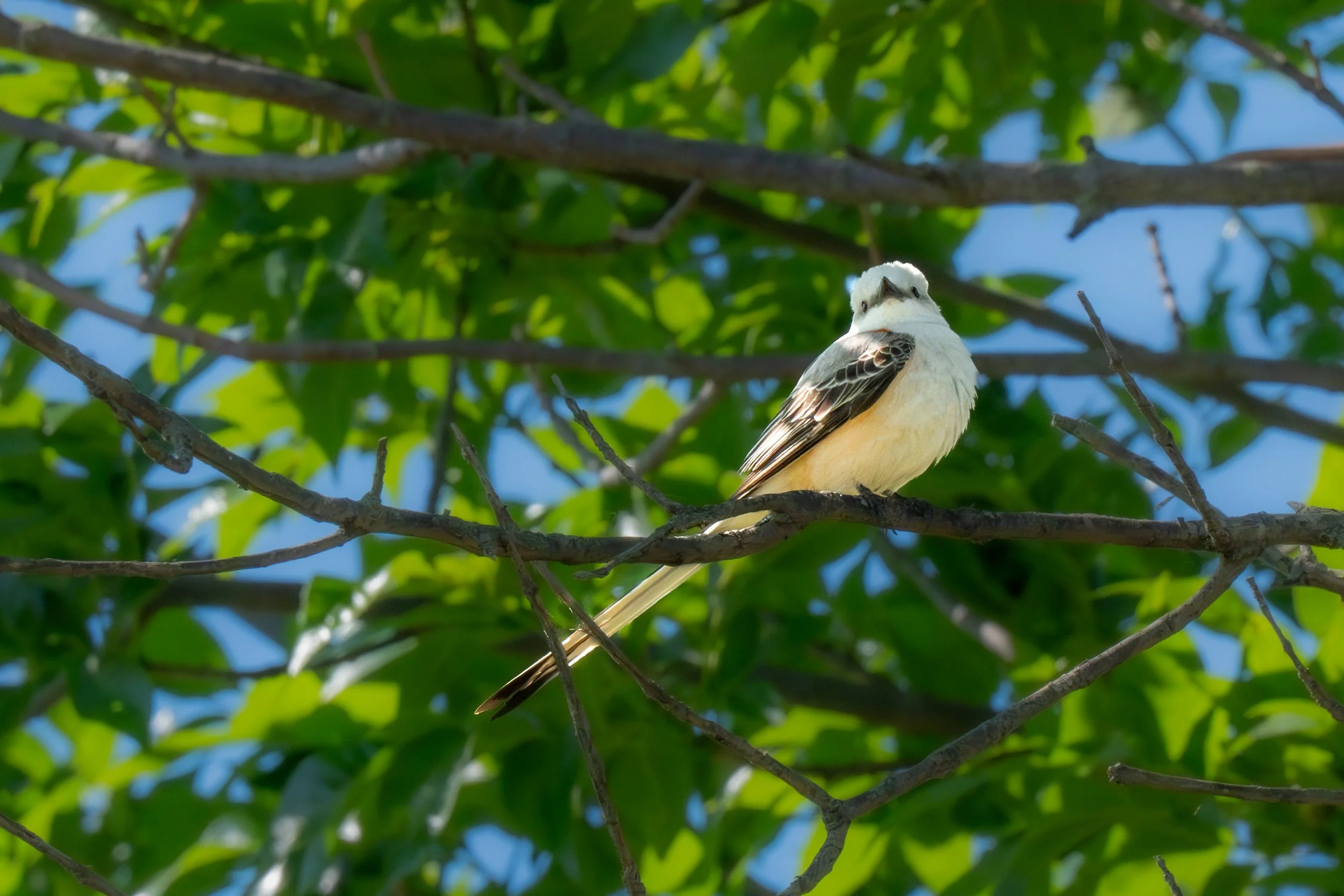
The Acrobat of the Prairie
A quiet encounter with a scissor-tailed flycatcher became a reminder that nature’s greatest beauty is often revealed in moments of stillness. This week’s photograph captures one of the prairie’s most graceful birds resting briefly between flights across the fields.
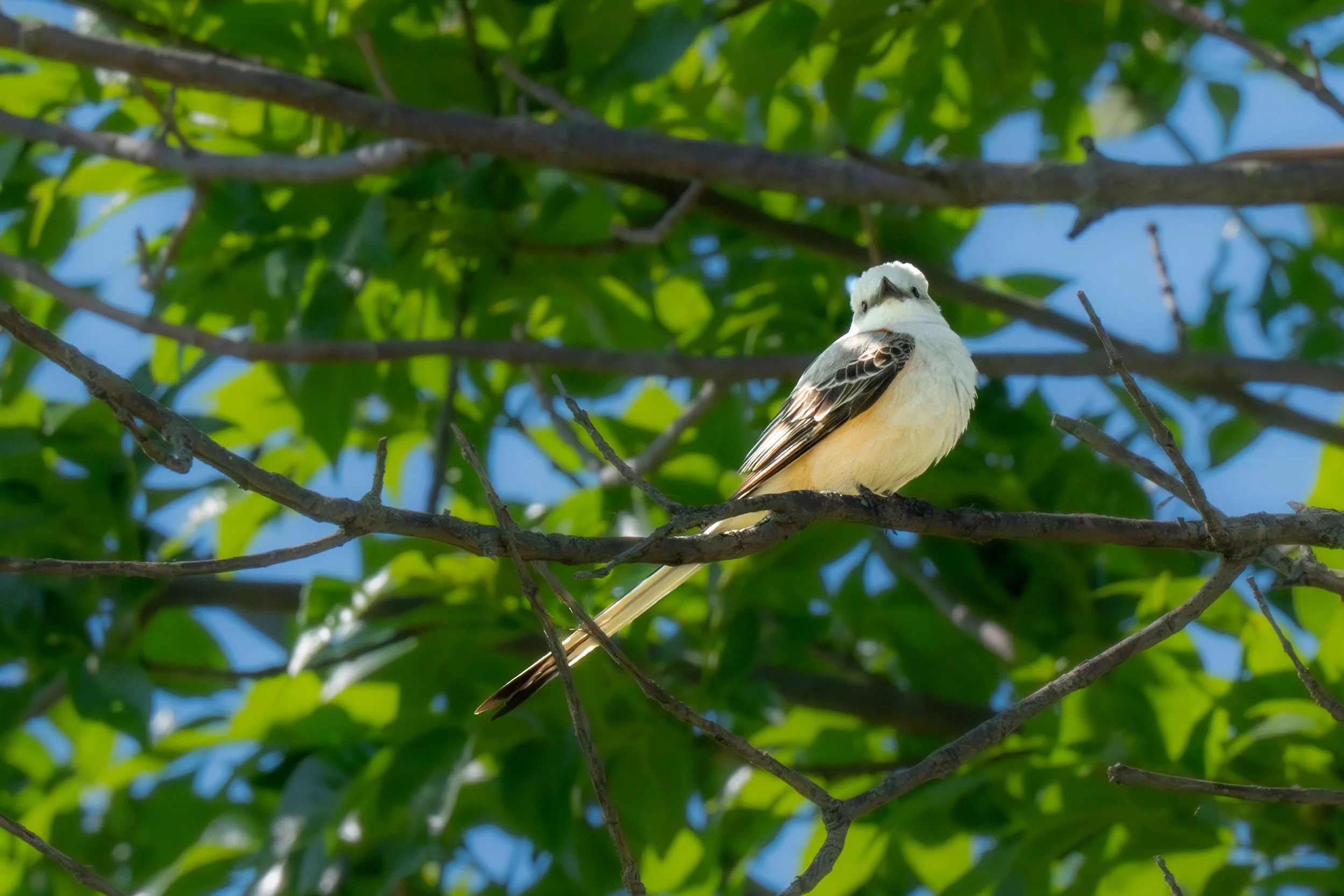
A quiet encounter with a scissor-tailed flycatcher.
There are some birds you admire from a distance, and then there are birds that seem almost impossible to truly see. The scissor-tailed flycatcher belongs in that second category. Long before you notice the details of its soft gray feathers or the faint salmon color beneath its wings, you notice the movement. They dart through open fields like living streamers, twisting and turning in pursuit of insects with breathtaking speed and precision. Their signature tail feathers act almost like a rudder, allowing them to pivot sharply in midair before disappearing across the pasture once again.
For years, I’ve tried to photograph these incredible birds. Like many wildlife photographers know, admiration does not guarantee opportunity. Scissor-tailed flycatchers are constantly moving, naturally cautious around people, and surprisingly difficult to track through a lens. More often than not, my images ended in frustration — wings blurred, focus missed, or the bird gone before I could react. Sometimes nature seems determined to remind us that beauty is not always easily captured.
That is why this moment felt different.
I had been sitting quietly near the edge of a field, simply watching and waiting, when this flycatcher suddenly landed in a nearby tree. For just a few moments, the chaos stopped. The bird rested calmly among the branches while sunlight filtered through the green leaves around it. Its long tail hung beneath the limb like a ribbon, and the subtle colors that are so easy to miss in flight finally became visible. It was close enough for me to study the delicate feather patterns and appreciate the elegance of a creature I usually only experience as motion.
Wildlife photography often teaches patience more than photography itself. We spend hours preparing, traveling, waiting, and observing for moments that may only last seconds. But sometimes those brief encounters become gifts. Not because the image is technically perfect, but because the experience stays with you long after the shutter closes.
This photograph reminds me that nature does not slow down for us very often. Yet every now and then, if we are quiet enough and patient enough, we are invited into a fleeting moment of stillness. And when that happens, it feels less like taking a photograph and more like receiving one.
Monk Reflection
The older I get, the more I realize how much of life resembles this scissor-tailed flycatcher. We rush from place to place, constantly moving, constantly chasing the next responsibility, opportunity, or distraction. Rarely do we slow down long enough to truly rest. Rarely do we allow others to see beyond the motion.
Yet some of the most meaningful moments in life happen in stillness.
This flycatcher spent most of the morning racing across the fields, impossible to follow for more than a second or two. But the photograph only became possible when the bird finally paused and settled quietly into the tree above me. In that brief stillness, beauty that had been hidden in motion became visible.
I think people are much the same way.
When our lives are constantly filled with noise and activity, it becomes difficult to notice wonder, gratitude, or even the presence of God around us. But when we slow down — even briefly — we begin to see things differently. We notice light filtering through the leaves. We hear the wind. We recognize blessings that were there all along.
Nature has a way of reminding me that stillness is not weakness. Sometimes it is in the quiet moments that the deepest beauty is finally revealed.
— Wandering Monk Photos
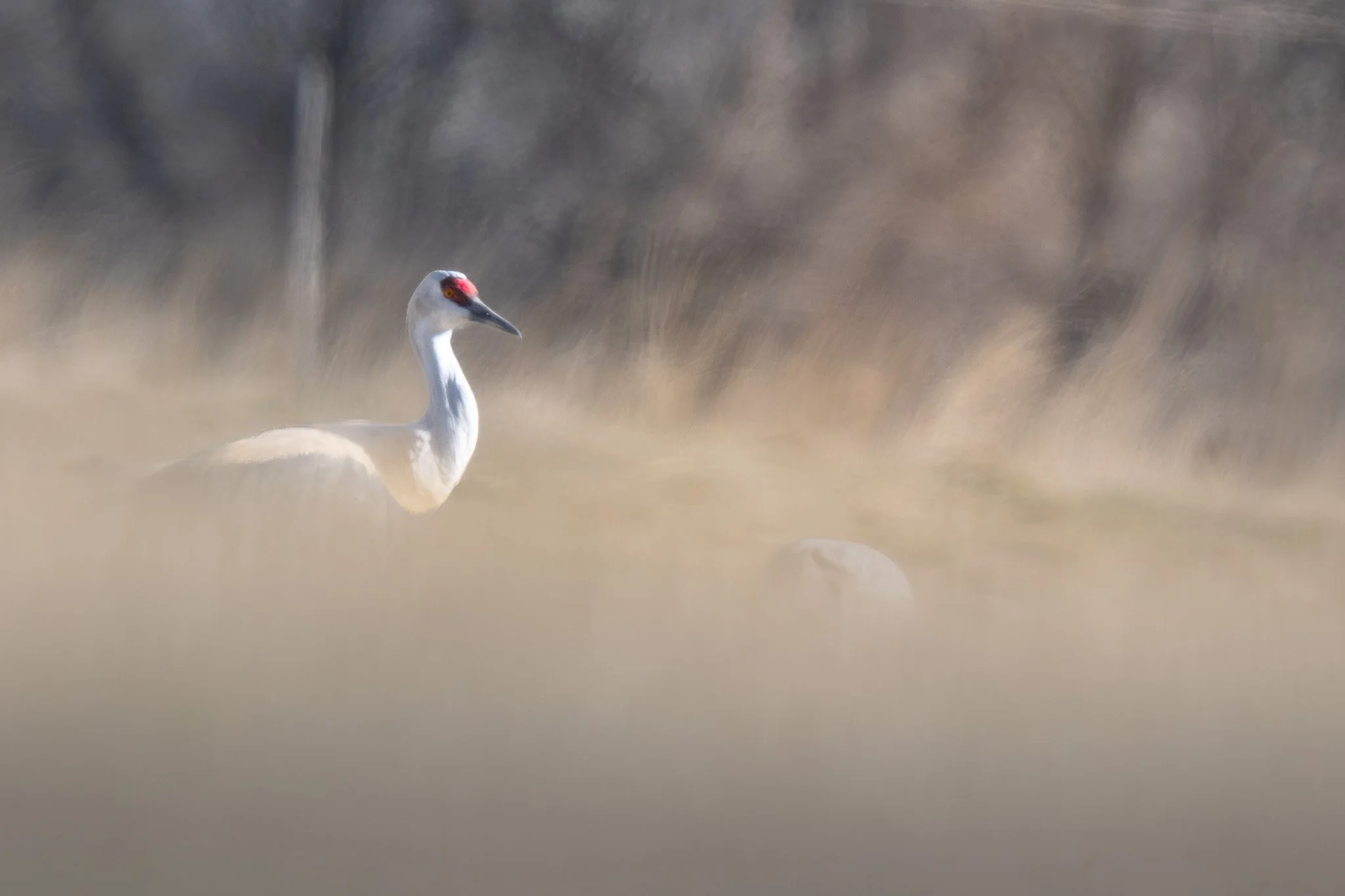
A Quiet Witness in the Cornfield
A single sandhill crane, partially hidden in a Nebraska cornfield, reveals a quieter side of migration—one that rewards patience, stillness, and a willingness to see from a lower perspective.
There are moments in wildlife photography when the grand spectacle gives way to something quieter—something more intimate. The sandhill crane migration near Kearney, Nebraska is often described in sweeping terms: hundreds of thousands of birds filling the sky, their calls echoing across the Platte River at sunrise. It is a breathtaking scene, and one that draws people from all over the world.
But this photograph is not about the sky.
It is about what happens after the noise fades.
On this particular morning, I left the riverbanks and followed the cranes to the surrounding farmland, where they spend their days feeding. The energy shifts here. The chaos of flight settles into a slow, deliberate rhythm—heads dipping into the remnants of last season’s corn, feet stepping carefully through the field, always alert, always aware.
Rather than stand above the scene, I chose to lower myself into it.
Lying in the grass at the edge of the field, I let the landscape rise up around me. The foreground softened into a gentle blur, the dry stalks becoming a veil rather than a distraction. Through that veil, one crane came into focus—calm, composed, and undisturbed. My presence, for once, did not alter the moment.
And that is what makes this image meaningful.
We often approach nature as observers from a distance, standing tall, looking out. But there is something transformative about choosing a lower perspective—about meeting creation at eye level, or even below it. It requires patience. It requires stillness. And, perhaps most importantly, it requires a willingness to let the moment come to you.
This crane wasn’t performing. It wasn’t part of a dramatic formation or silhouetted against a painted sky. It was simply living—feeding, moving, existing within the quiet rhythm of its day.
And in that simplicity, there is a kind of beauty we often overlook.
For me, this image serves as a reminder that not every powerful moment announces itself with grandeur. Some of the most meaningful encounters are found when we slow down, lower our vantage point, and pay attention to what is right in front of us.
The migration is extraordinary.
But so is this.
___________________________________________________________________________________________________________________________________________________________________
Monk Reflection:
Sometimes the clearest view comes when we choose to lower ourselves—physically, mentally, and spiritually. In the quiet places, beyond the spectacle, we often find what we were truly looking for all along.
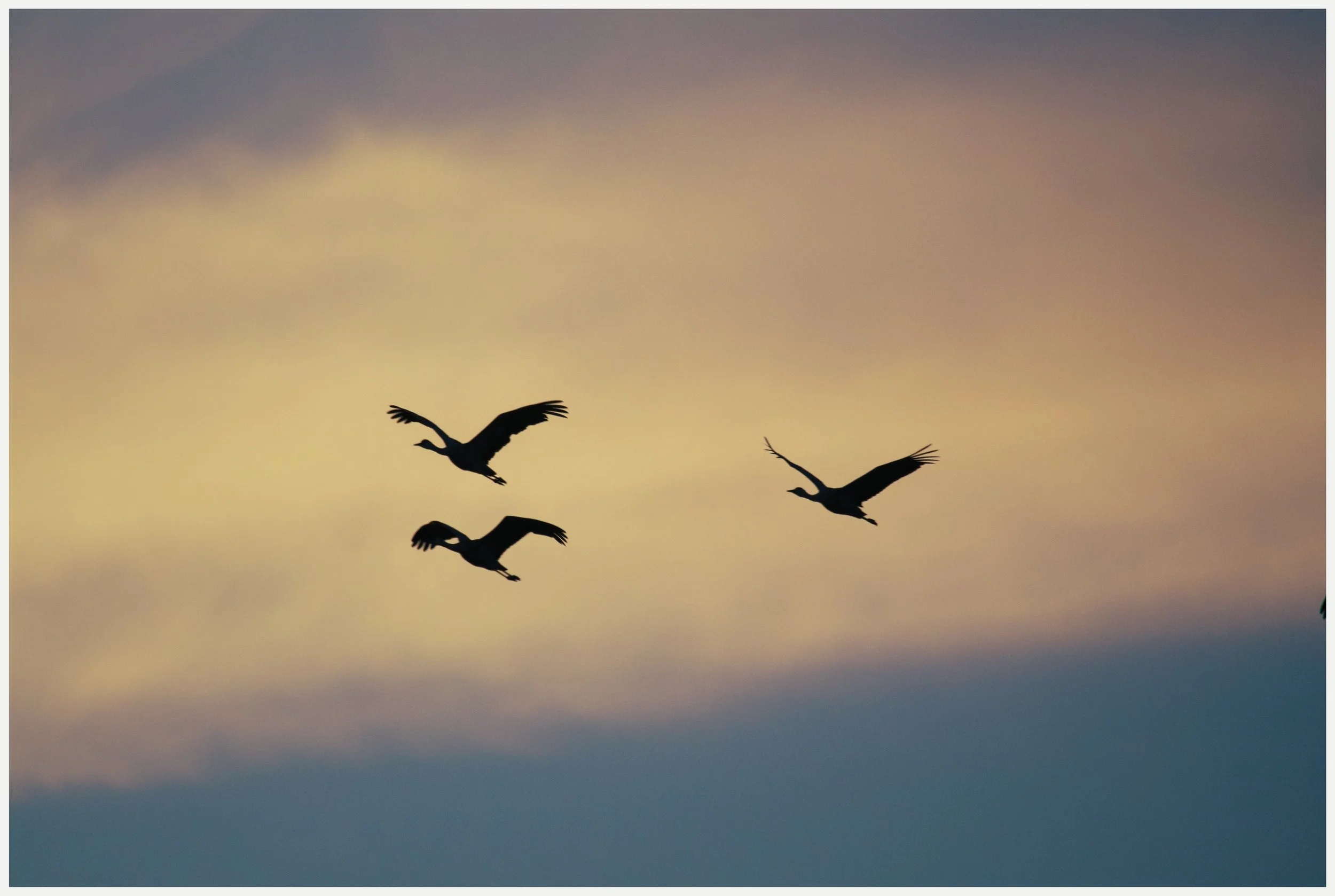
Sandhill Crane Migration at the Platte River: A Pastel Evening in Flight
A quiet evening along the Platte River reveals three Sandhill Cranes crossing a pastel sky—part of one of North America’s greatest migrations.
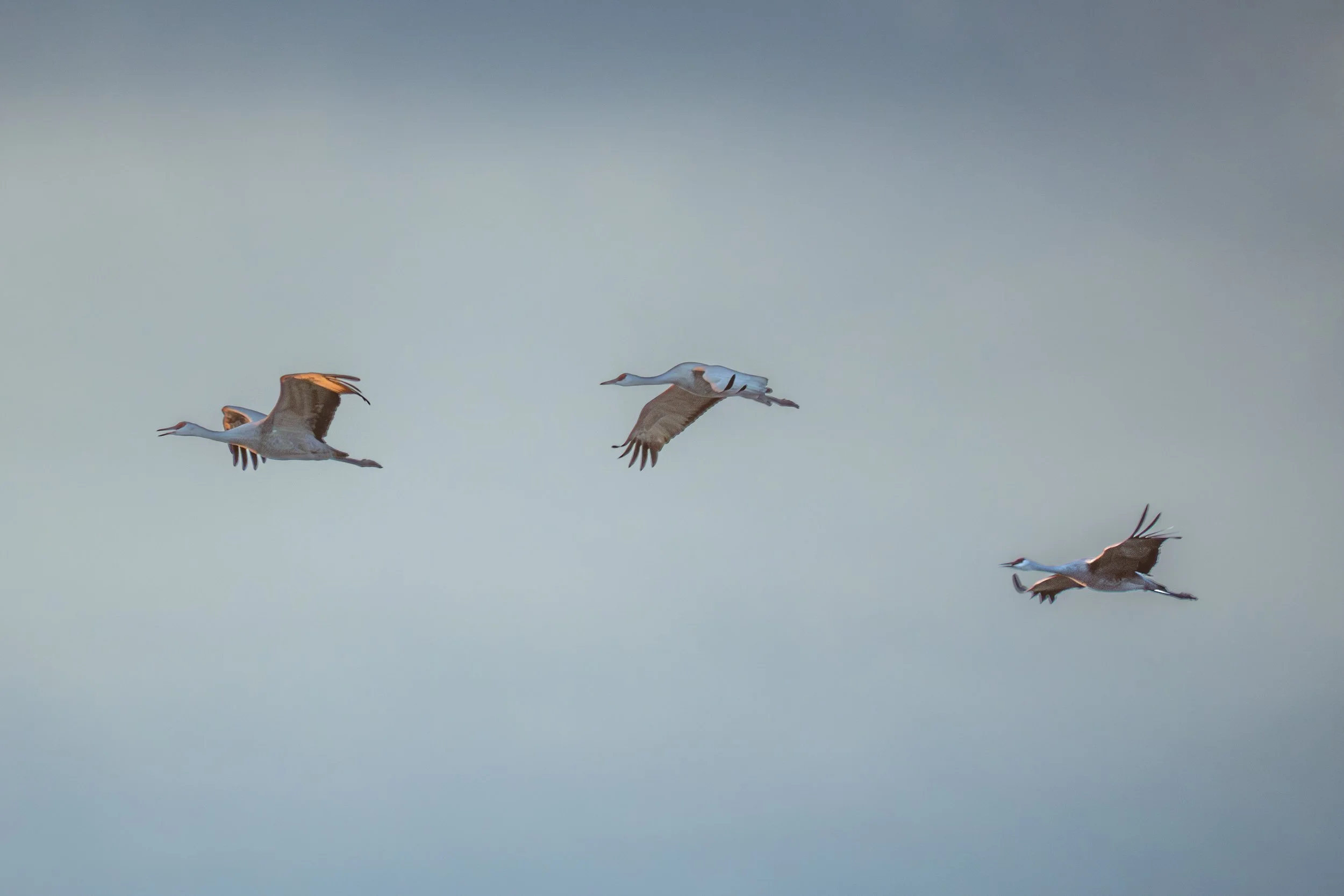
Sandhill Cranes fly toward the Platte River
A Pastel Crossing on the Platte River
There are moments in nature when everything softens—the light, the wind, even the rhythm of your own breathing. This photograph was taken during one of those moments along the Platte River near Kearney, as the day gave way to evening and the sky dissolved into gentle shades of pink, lavender, and gold.
Three Sandhill Crane silhouettes move across that canvas—quiet, deliberate, and timeless. They are just three among more than half a million cranes passing through this narrow stretch of Nebraska, yet in this frame, they carry the full weight of the journey.
A River That Becomes a Refuge
Each spring, the Platte River transforms into one of the greatest gathering places in the natural world. Cranes arrive from their winter homes in Texas and Mexico, drawn here by something ancient and unchanging. For a few short weeks, this river becomes a sanctuary.
By night, they stand in the shallow braided channels—close together, watchful, protected by the open water. At dawn, they rise in great waves, their calls echoing across the prairie as they head to nearby fields to feed. And by evening, like breath returning to the body, they come back again.
This rhythm—rest, rise, return—has played out for generations beyond counting.
The Beauty of the In-Between
This image lives in the in-between space.
Not the drama of thousands lifting at sunrise.
Not the thunder of wings at full migration.
But something quieter.
Three cranes. A fading sky. A moment easily missed.
And yet, this is where the story becomes personal. Because the grandeur of migration is not only found in vast numbers—it is revealed in the stillness of a single passing group, in the hush between movements, in the space where you are simply present enough to notice.
Monk Reflection
There is a wisdom written into the lives of these cranes.
They do not rush the journey.
They do not skip the resting place.
They return, again and again, to what sustains them.
Watching them, it’s hard not to wonder how often we move through our own seasons without pause—pushing forward without honoring the need to rest, to gather, to simply be.
The cranes remind us:
Even the longest journeys are meant to be lived in rhythms.
And sometimes, the most meaningful moments are not found in the spectacle…
but in the quiet crossing of three birds against a painted sky.
Check out the video of this adventure and subscribe to my YouTube Channel, “Monk Reflections.” Here is the video link -
Sandhill Cranes at the Platte River — Here's What 500,000 Birds Looks Like
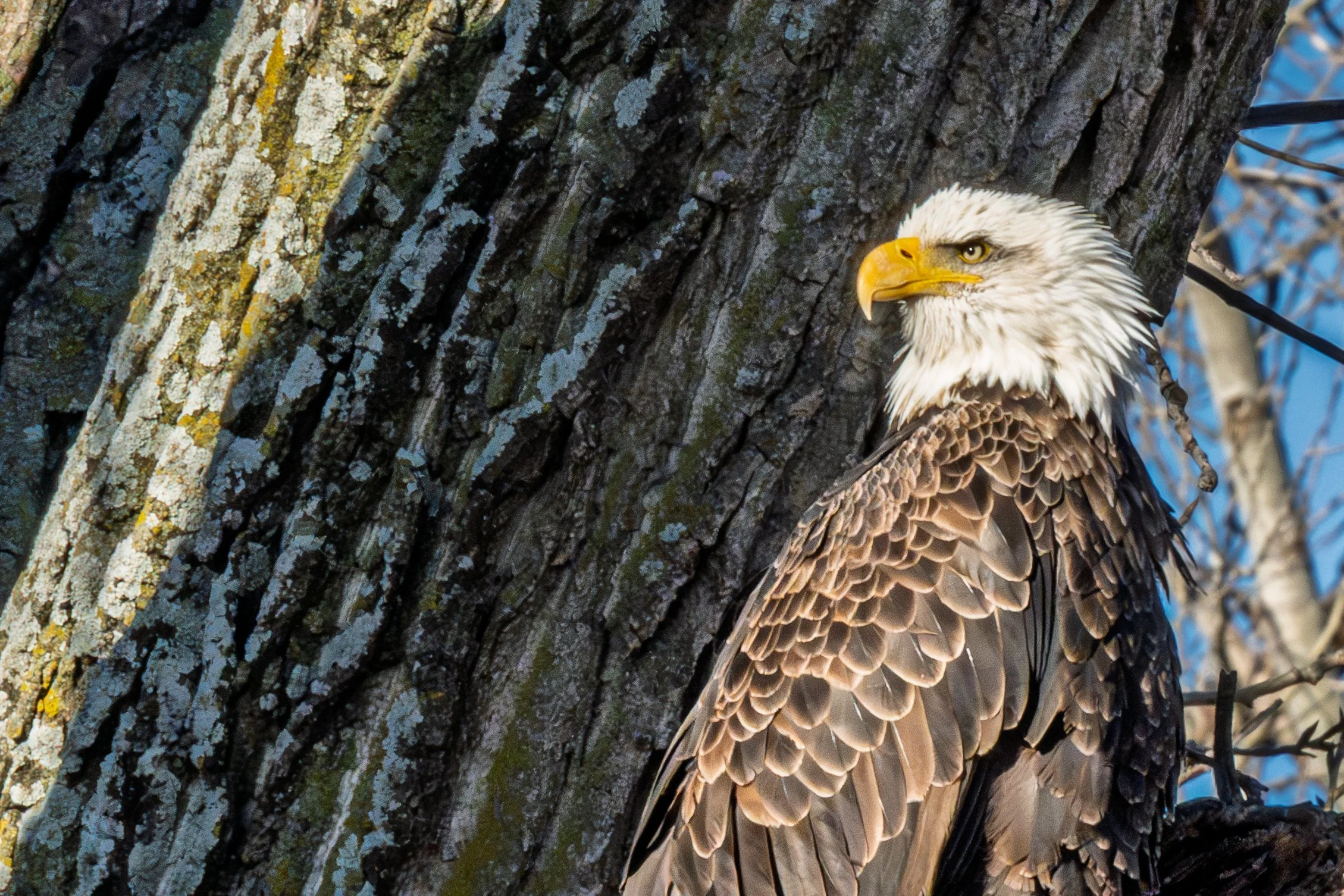
Bald Eagle Migration at Loess Bluffs: A Winter Wildlife Reflection
A solitary bald eagle perched high in a bare cottonwood, overlooking a marsh filled with thousands of geese and swans below. Morning light brushes the scene with gold, while the water shimmers beneath the restless movement of wings.
Witness over 1,000 bald eagles and thousands of waterfowl at Loess Bluffs, Missouri—an unforgettable winter wildlife experience and reflection on patience in nature.
A solitary bald eagle perched high in a bare cottonwood, overlooking a marsh filled with thousands of geese and swans below. Morning light brushes the scene with gold, while the water shimmers beneath the restless movement of wings.
There is always one moment in the field that stays with me longer than the rest. Not the loudest or most dramatic—but the one that quietly anchors everything else. At Loess Bluffs, it was this: a single bald eagle perched in stillness above a restless world. Beneath him, the marsh churned with life. Snow geese lifted in great, swirling clouds. Canada geese called out in steady, familiar rhythms. Trumpeter swans moved like drifting light across the water. And yet, above it all, the eagle remained unmoved—watchful, patient, grounded.
I remember raising my camera, then hesitating.
The instinct is always to shoot quickly when everything is happening at once. But something about that moment asked for restraint. The eagle wasn’t hunting—not yet. He was observing, waiting, reading the movement below with a kind of quiet authority. So I slowed down. I watched the way the morning light caught the white of his head against the dark branches. I waited for the subtle turn, the slight shift that would bring the scene into balance. And when I finally pressed the shutter, it felt less like capturing an image and more like entering into the rhythm of the moment itself.
Photography often teaches me what I’m unwilling to practice elsewhere.
I rush. I anticipate. I try to force meaning instead of allowing it to unfold. But standing there, beneath that cottonwood, I was reminded that clarity rarely comes through urgency. The eagle did not need to chase the moment—it would come in its own time. Strength, in that space, looked like stillness. Awareness. Trust.
When I look at this photograph now, I don’t just see a bird above a marsh. I see a posture—a way of being I am still learning. To be present without striving. To observe without controlling. To wait without anxiety. The world below may surge with noise and motion, but there is always an invitation to rise above it, to find a quiet place of perspective.
Sometimes the most powerful thing we can do is simply watch…and be ready.
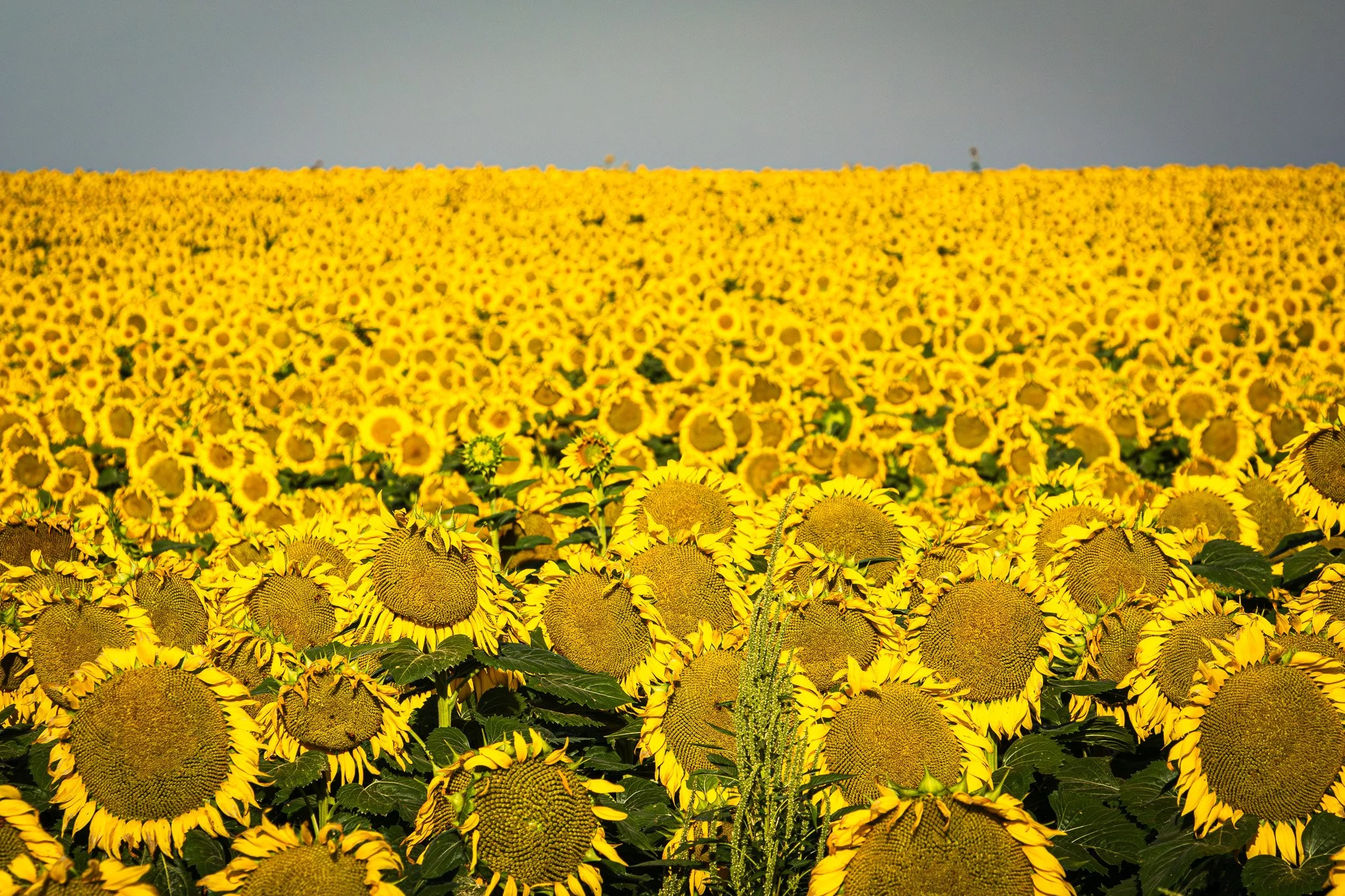
How to Take Better Nature Photos Without Expensive Gear | Sunflower Field Story
There’s a common belief in photography that better gear leads to better photos. Bigger lenses, newer cameras, sharper glass. For a long time, I thought that mattered more than anything else.
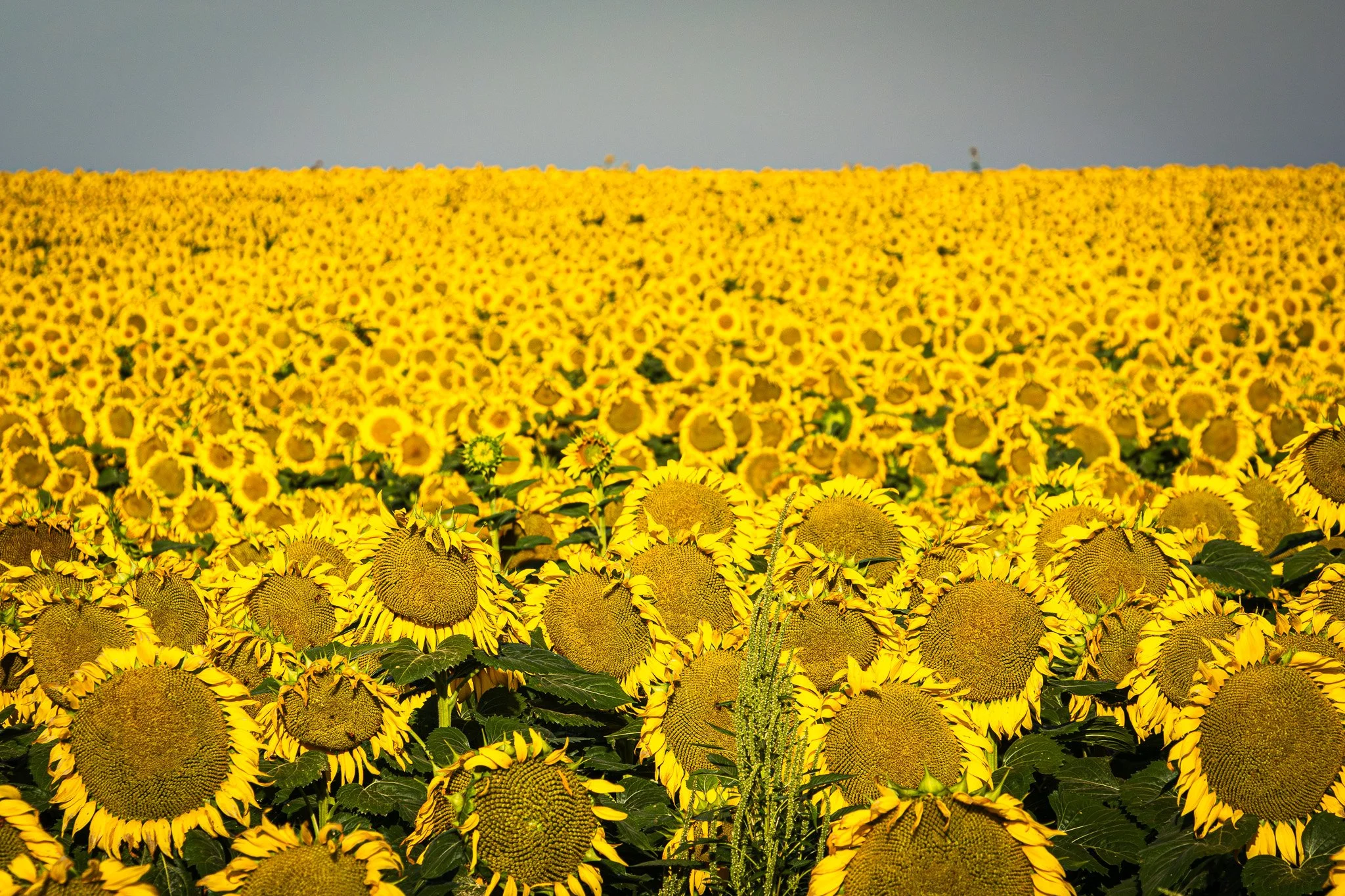
Plains of sunflowers stretch across the prairie. Taken at Lake Scott State Park, Kansas.
There’s a common belief in photography that better gear leads to better photos. Bigger lenses, newer cameras, sharper glass. For a long time, I thought that mattered more than anything else.
But somewhere out in western Kansas, standing before a vast field of sunflowers, that idea began to fade.
The camera in my hands wasn’t anything special. Nothing about it would impress a gear list or spark a debate online. But the scene in front of me didn’t need anything more.
Rows of sunflowers stretched across the land, each one turning toward the light like it knew exactly where to look. The wind moved through them in soft waves, and for a moment, everything felt still—even though nothing was actually standing still at all.
That’s when I was reminded: better photography rarely begins with better equipment. It begins with attention.
Slow Down Before You Ever Press the Shutter
Standing at the edge of that sunflower field, it would have been easy to start shooting immediately. Wide shots, close shots, details—move quickly before the moment changes.
Instead, I paused.
I watched how the light touched the tops of the flowers first, then slowly worked its way down the field. I noticed how the rows created natural lines that pulled the eye into the distance. I waited until I felt like I understood the scene before trying to capture it.
That small decision changed everything about the photos I took.
Learn Light Instead of Chasing Equipment
In western Kansas, light can feel wide and honest. There’s little to block it, nothing to soften it unless the sky decides to do so.
On this day, the sun sat low enough to cast a warm glow across the field. The sunflowers weren’t just yellow—they were glowing, each petal catching light differently depending on its angle.
No lens can replace that kind of light. But any photographer can learn to recognize it.
Get Closer (Physically and Emotionally)
A sunflower field is naturally impressive from a distance. It’s tempting to keep it all in frame—to show the scale and the sweep of it.
But the strongest images often came when I moved closer.
One flower leaning slightly away from the rest. A cluster of petals catching backlight. A single stem standing just a bit taller than the others.
The field became less about size—and more about presence.
Work With What You Have
There was nothing special about the gear I used that day. No secret lens. No technical advantage.
But limitations have a way of focusing your attention.
Instead of thinking about what I couldn’t do, I focused on what was right in front of me: composition, light, and timing.
Those three things will always matter more than specifications.
Be Patient—Nature Works on Its Own Time
A sunflower field changes constantly. Clouds shift. Wind passes through. Light moves across the land like it’s never going to repeat itself—and it won’t.
I stayed longer than I originally planned. I waited for moments where the wind softened, where the light settled just right, where the field seemed to pause between movements.
Those are the moments you don’t rush.
They arrive on their own.
Focus on Meaning, Not Perfection
When I look back at that day, I don’t remember camera settings or technical details.
I remember the feeling of standing in a field that seemed to stretch farther than it should. I remember the quiet rhythm of the wind moving through the flowers. I remember how small I felt in the best possible way.
And that’s what the photo carries forward.
Not perfection—but presence.
Final Thoughts
Photography has a way of teaching you how to see again.
Not just to look at a scene, but to notice it.
That sunflower field in western Kansas didn’t need expensive equipment to be beautiful. It only needed someone willing to stop long enough to pay attention.
And that’s still where the best images begin.

Driving Industry
Recently, I completed the project planned for this year. The goal was to visit twelve historic sites that would highlight the story of Kansas’ history. The sites ranged from prehistoric land that sat at the floor of a large, shallow intercontinental ocean to the modern age of technology and industry. I photographed each site at night, most with the beautiful Milky Way galactic core rising above the landmark. Those photos have been used in my new calendar for 2026.
Behind the Camera
Recently, I completed the project planned for this year. The goal was to visit twelve historic sites that would highlight the story of Kansas’ history. The sites ranged from prehistoric land that sat at the floor of a large, shallow intercontinental ocean to the modern age of technology and industry. I photographed each site at night, most with the beautiful Milky Way galactic core rising above the landmark. Those photos have been used in my new calendar for 2026. That calendar is pretty good, if I do say so myself.
As I traveled there was one photograph that I was looking to discover. One photograph to summarize the story of the project. One photograph that I never discovered. That is until after the calendar was completed and sent off to the printer.
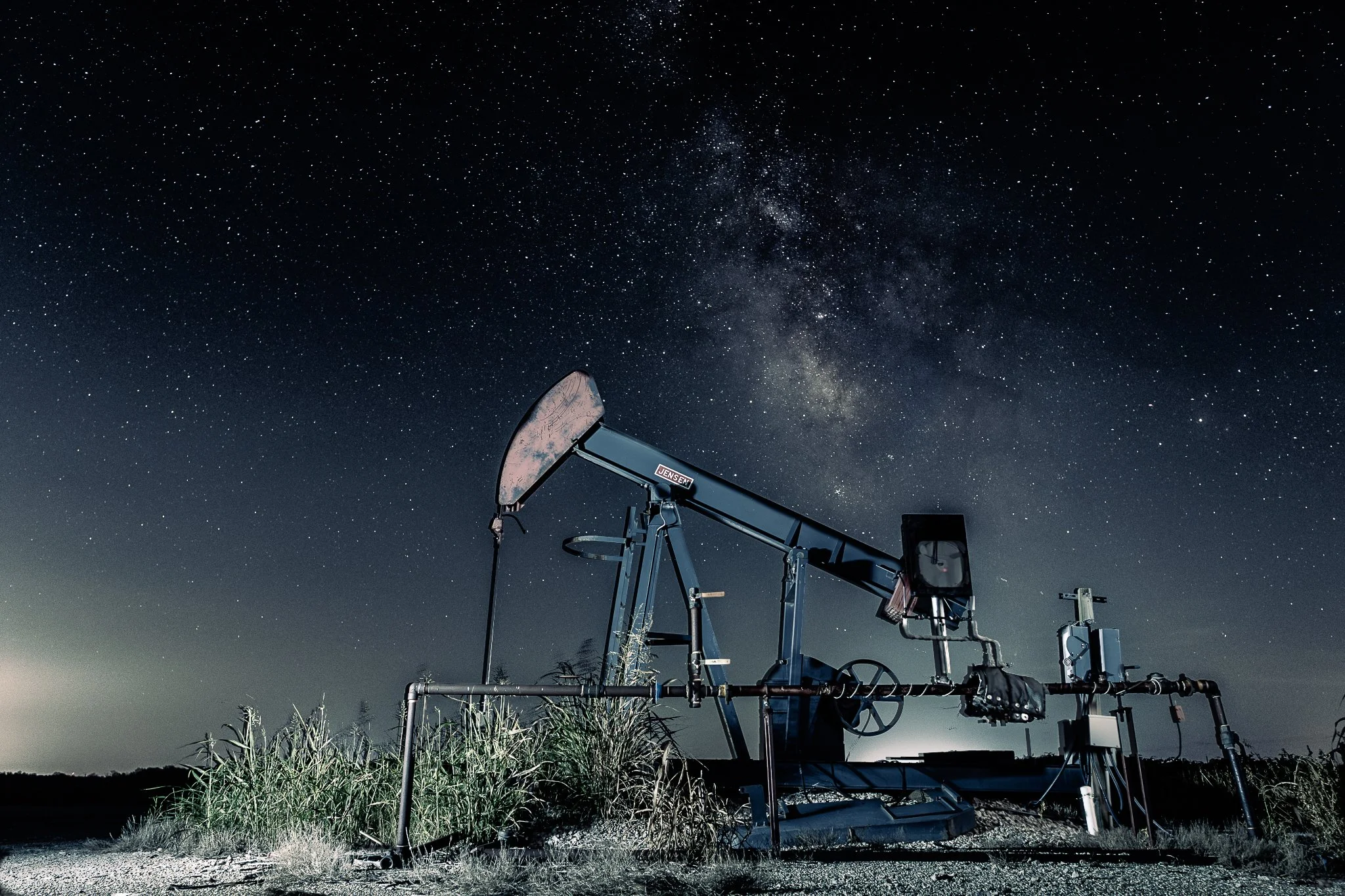
Those jewels of nature often pop up in the most unexpected times and places. This was no different. I was driving from my home in southeast Kansas to the Honda service center in Bartlesville, Oklahoma. It’s only about a 45-minute drive. I was still in Kansas when I saw an old oil pump in the middle of an open field.
That may not sound exciting, but I am learning that when something grabs my attention then it’s time to stop and explore a little more. Pulling the car off the highway, I noticed several things. First, the position of the pump. It seems that most pumps face the east and west. I don’t know why that is, but it just is. I look for subjects that face north and south (preferably north), because the Milky Way rises in the southern sky. Second, I look for the background. Cluttered backgrounds are more challenging to photograph the night sky. Especially if the scene needs a panorama (A panorama is several photographs taken side-by-side and stitched together as a single image). Finally, I like to set the camera low and aim the lens upward to catch the subject and the sky.
This particular oil pump checked all the blocks; facing north, open field behind, and the gravel road leading to the pump was perfect for the high angle composition that I was hoping to find. Also, a new moon was only days away and the moon would rise a couple of hours after the Milky Way. The coup de grace was that tonight’s weather forecast was for clear skies!
Taking note of the location of this gem, I continued to my car appointment. In the evening, I returned to this site for a wonderful reward. The only downside was the small community airport sat off to the southwestern edge of the scene. The light beacon of the control tower turned and flashed through the lower sky. I didn’t notice this during the daylight and I’m glad. Otherwise, I may have been tempted to keep looking for another candidate.
I decided to set up and take the shot anyway. I’m so glad that I did! This was the image I was looking for. The timeless beauty of the Milky Way over the prairie leading to the oil pump that helped to drive the industrial revolution in Kansas.
Now I am going on a new adventure to walk an ancient path in Spain. As you read this, I am walking the Camino de Santiago. Be sure to watch with me on my YouTube channel at www.YouTube.com/@wanderingmonkhikes.
Geek Speak
This was a fun photograph that includes blending several foreground photos and a photo exposed for the night sky to get the rich Milky Way core. The foreground photos were taken with a Sony a6700 camera and a Sigma 16mm, f/1.4 lens. This image is actually six photographs taken with a shutter speed of 15 seconds at f/5 to get the greatest depth of field possible. This helps with overall sharpness. The ISO was set to 800 and the white balance was 3800 kelvin.
With the settings as described, I began “light painting” different parts of the ground and the pump. Shining my headlamp on its lowest setting while the shutter was open, it a technique to highlight the details of the foreground. This takes a little experimenting, but soon the image takes shape. After shining the light from the right and left sides (never directly from the position of the camera), shadows can be eliminated or accentuated to taste. The photos are then blended in post editing.
Turning to the sky, I used my faithful settings of f/1.4, shutter speed of 10 seconds, ISO of 3200, and white balance at 3800 kelvin. These setting pull in the stars, but darken the foreground (which is replaced with the other images).
In post editing, I use Affinity Photo 2, the images are blended together to create this view. I hope you enjoy it.

Beautiful Badlands
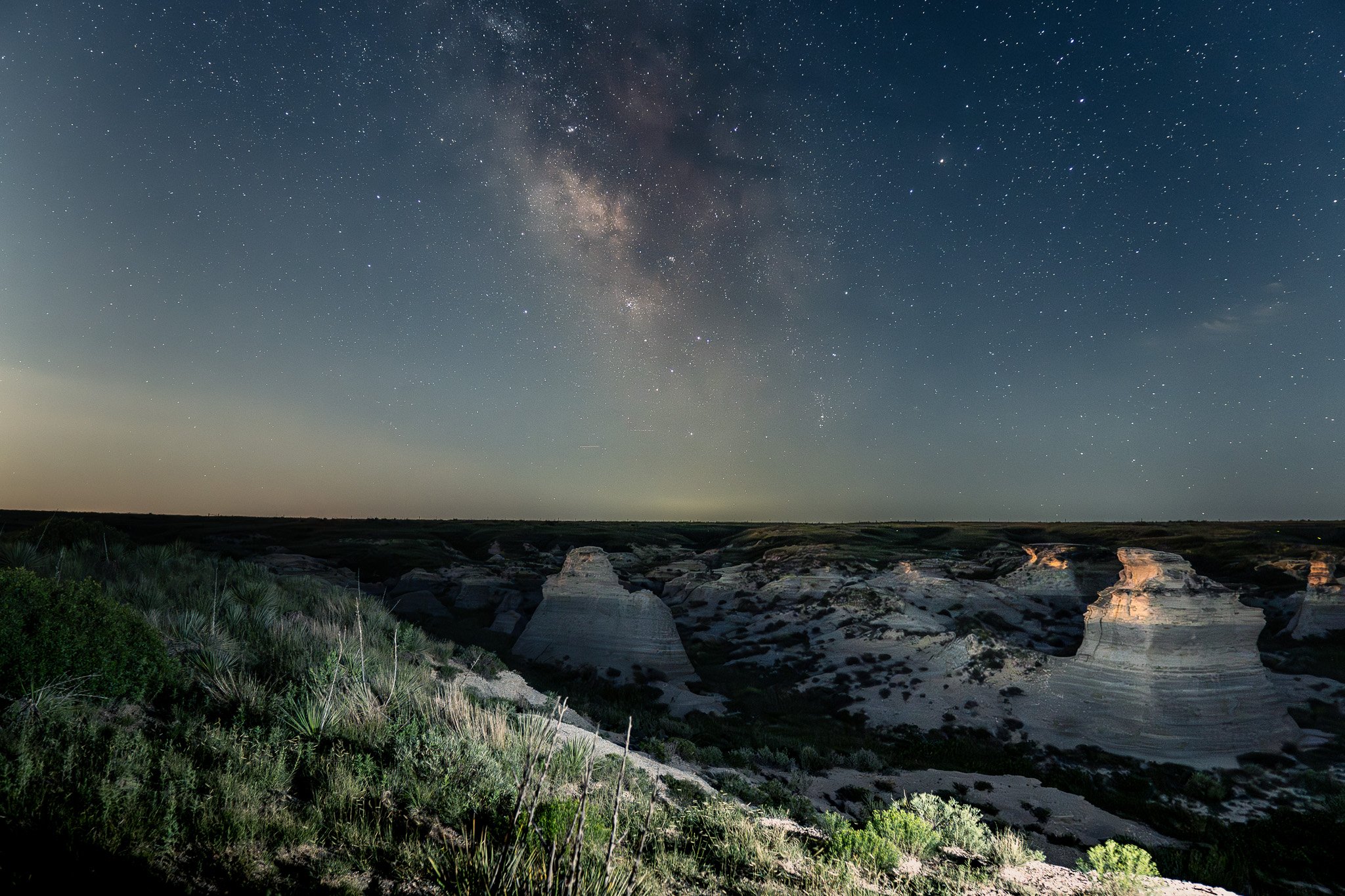
The land itself is called “badlands” but what I witnessed was beautiful badlands. The open plains of western Kansas is like a large flat floor. Suddenly, the floor opens and there in an unexpected canyon the great chalk-stone pillars reach upward. As if they are attempting to claw their way to the sky.
Beautiful Badlands
Behind the Camera.
I am convinced that beauty can be seen in every place. Sure, some require a little more searching, a little more effort to discover the hidden treasures, but somewhere there is a spark, a glitter, a jewel waiting to share its splendor to the explorer, its reward to the one who seeks it out. This belief in beauty motivates me to venture out of the comforts of home and into the wilds of nature. What about you? Is there a seed of desire, perhaps deeply planted in the core of your soul, yearning to discover hidden beauty?
This wanderlust, as its sometimes called, led me to western Kansas. I visited this place three years ago. I had read about some unique rock formations near Lake Scott State Park. After driving nearly 400 miles across Kansas, I came to Little Jerusalem Badlands State Park. Little Jerusalem sits between Oakley and Scott City. It is a geological marvel and a historical landmark.
Some say that this place got its name because from a distance it looks like the ancient walls of Jerusalem. George Custer once settled in the area. Native people roamed the area and a battle between people led by Chief Little Wolf and Colonel William Lewis was fought in the area. Wagon trains and stagecoach lines transited through here. They called the formations “Castle City.”
Apache, Commanche, and Kiowa traveled through this land. Before people lived here, this was home to a very different environment. Part of a vast intercontinental ocean, these formations were formed from sediment on the ocean floor. Fossils of prehistoric sea creatures remain throughout the area. Fossilized sharks teeth and mollusks have been discovered in road cuts.
The land itself is call “badlands” but what I witnessed was beautiful badlands. The open plains of western Kansas is like a large flat floor. Suddenly, the floor opens and there in an unexpected canyon the great chalk-stone pillars reach upward. As if they are attempting to claw their way to the sky.
When one looks at the clear night sky, filled with billions of stars, the reason for the upward reach of these strange rocks becomes more apparent. It is too beautiful to remain at the canyon bottom. Even the rocks look upward to see the beauty of the Milky Way as it streaks across the sky over Little Jerusalem Badlands.
Geek Speak.
I tried to get this photo once before. Unfortunately, the clouds obscured the galactic core and I tried to do too much with the composition. I tend to make things more complicated than they need to be, and it shows in the final product.
However, this night the sky was clear. A full moon was preparing to rise and threatened to blow out the sky, but there was a narrow window of time for the photograph. So, I setup my Sony a6700 camera on a tripod. Using a Sigma 16mm, f/1.4 lens, I planned a single exposure. My settings at this 16mm focal length were an aperture of f/2.2 and ISO at 3200. The shutter speed was set to 8 seconds.
With the lowest light setting on my headlamp, I set the timer for 10 seconds. Triggering the shutter, I ran about 10 feet to the right of the camera and “light painted” the grass in the foreground. I then took a second image, this time turning the light setting on my headlamp to its strongest setting. Once again, I ran about 10 feet to the right and painted the rock formations down inside the canyon. Back at the studio, I blended these photos and the result was this image of the Milky Way extending over the park. This is “Beautiful Badlands.”

Little Things That Stretch Our Limits
It’s good to push yourself, stretch your abilities, and try the seemingly impossible. That is the story of this photograph. This is a barn swallow. It’s one of hundreds that were flying about, darting in and out of the building that I had come to photograph on this trip.

Barn Swallow
Behind the camera.
It’s good to push yourself, stretch your abilities, and try the seemingly impossible. That is the story of this photograph. This is a barn swallow. It’s one of hundreds that were flying about, darting in and out of the building that I had come to photograph on this trip.
To get a feeling of this challenge, go to a baseball game and try to photograph a curve ball thrown from pitcher to catcher and get a clear, sharp image. Well, these birds are about the size of a baseball, and they dart around extremely fast. I sat and observed to see if there was a flight pattern that would help me predict how they would fly, but I couldn’t observe any sort of pattern.
After an hour of just observing, I realized the swallows were hunting. They were catching flying insects and darting about to snatch other flying things out of the air. So, that added to the fascination and the challenge to photograph the birds.
I had come to this place in search of an old church building. A photo of the building was posted on Facebook. Directions were vague. I knew that it was in Phillips County, Kansas and somewhere north of the small town of Agra. Agra is a 5-1/2 hour drive from my home in southeast Kansas. The town is less that 15 miles from the Nebraska border. However, the photo showed the church deteriorating and I knew that it would not be around in the future. So, it was a mission to photograph the church. I hoped to photograph a sunset and the Milky Way extending over the old building.
The local farmer who owns the land where the church is located, was working his fields. I spoke with him and with his permission, stayed the night to take photos. When I sat up my gear inside the building, I discovered at least twenty barn swallow nests along the ceiling. There was stillness interrupted by a flurry of swallows flying through the window openings. They were bringing their insects to feed the young in the nests.
The swallows fly around checking me out, but soon they realized that I was no threat and they ignored my presence. It was fascinating to watch them through the evening.
I returned outside to sit and watch and try to photograph these little darts. It was a challenge to just acquire the birds in the camera’s viewfinder. Tracking a bird long enough to take the photo was another level of difficulty. Then to get a photograph with the right lighting, distance, and stability was nearly impossible. However, persistence pays off sometimes. Out of forty-five photographs that I took that evening, this one is worth sharing. It isn’t perfect, but it feels like success.
Geek speak.
If you read the story of this photograph, you know this was a challenging experience. I was using my Sony 200-600mm, f/5.6-6.3 G lens on a Sony a6700 camera. With the focal length set to 350mmm and the aperture at f/6.3, I could set the shutter speed to 1/3200 of a second to freeze the motion of the birds and still have enough light exposure to get the details. All that I needed was for a bird to fly toward me at the right height.
As I wrote earlier, I took forty-five photos that evening. Some only captured part of a bird as it suddenly darted out of the frame. Some were flying away and were just uninteresting. Others were too far or too near or flying into the setting sun. However, this one was just right. Flying about 30 feet away, it was curious about what I was doing and turned to fly over my head. As he did, I got this photograph. It isn’t perfect, but I had been pushed to use my limited photography skills. It certainly stretched my abilities. And I had captured what seemed at first to be impossible. I hope you enjoy it.

Hum that Tune
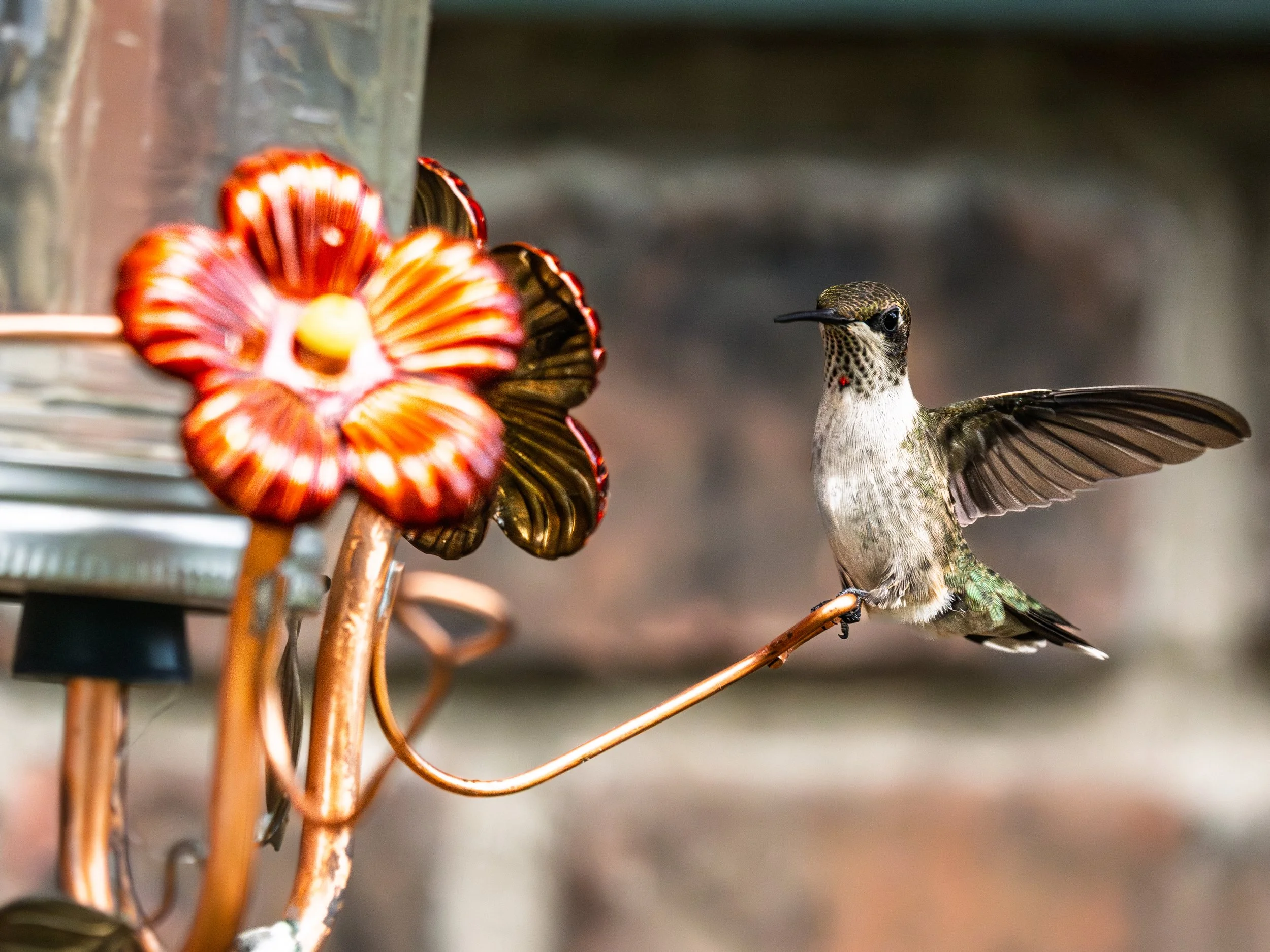
There are more than 350 species of hummingbirds, but the one in this photograph was a very young Ruby-throated hummingbird. Do you see the tiny red dot in the middle of his neck?
Behind the camera.
Hey y’all, come on in. Gathering around and get comfortable. Do you want a drink? Fix something, but don’t be long. I want to tell a story.
Each spring an amazing thing happens. The smallest of birds leave their homes in southern Mexico. Flapping their wings at more than sixty times per second, they set a course north. They cross the United States and fly to Canada and Alaska. Their annual trek covers more than 3,000 miles. They can fly 500 miles nonstop across the gulf during spring and fall migrations. Some stick to the coast and travel the longer route along the edge of Texas.
Hummingbird’s wings create a humming sound that gives these birds their name, the “hummingbirds.” You have seen them, darting about, hovering and drinking nectar from flowers or maybe a feeder designed just for their long, thin beaks. These are the only birds that can fly backwards. A handy trick to move in and out of their favorite feeding spots.
Hummingbirds have a remarkable memory and often choose their favorite places to return year after year. Three years ago, I place a feeder in our front flower bed. Within minutes, two birds were hovering. They began drinking the homemade nectar that we brewed from sugar and water.
There are more than 350 species of hummingbirds, but the one in this photograph was a very young Ruby-throated hummingbird. Do you see the tiny red dot in the middle of his neck?
Each year, around May, we wait for our friends to return on their journey north. We try to make sure they have nectar to drink, to refuel as they prepare to continue their journey north. This little one has grown and his throat is fully developed with bejeweled red feathers. It’s always exciting to see them darting around in the air and hearing the hum of their wings.
Tell me where you have seen hummingbirds near you.
Geek speak.
Hummingbirds flap their wings so fast that it is challenging to freeze the action for a photograph. This guy was photographed with a Sony a6700 camera and a Sony 200-600mm lens. The focal length was 200mm and the shutter speed was 1/4000th of a second. The aperture was set a f/5.6, using an ISO of 1000. This blurred the background and captured the bird’s wings in flight. Modern editing programs have helped remove much of the noise associated with high ISO settings.
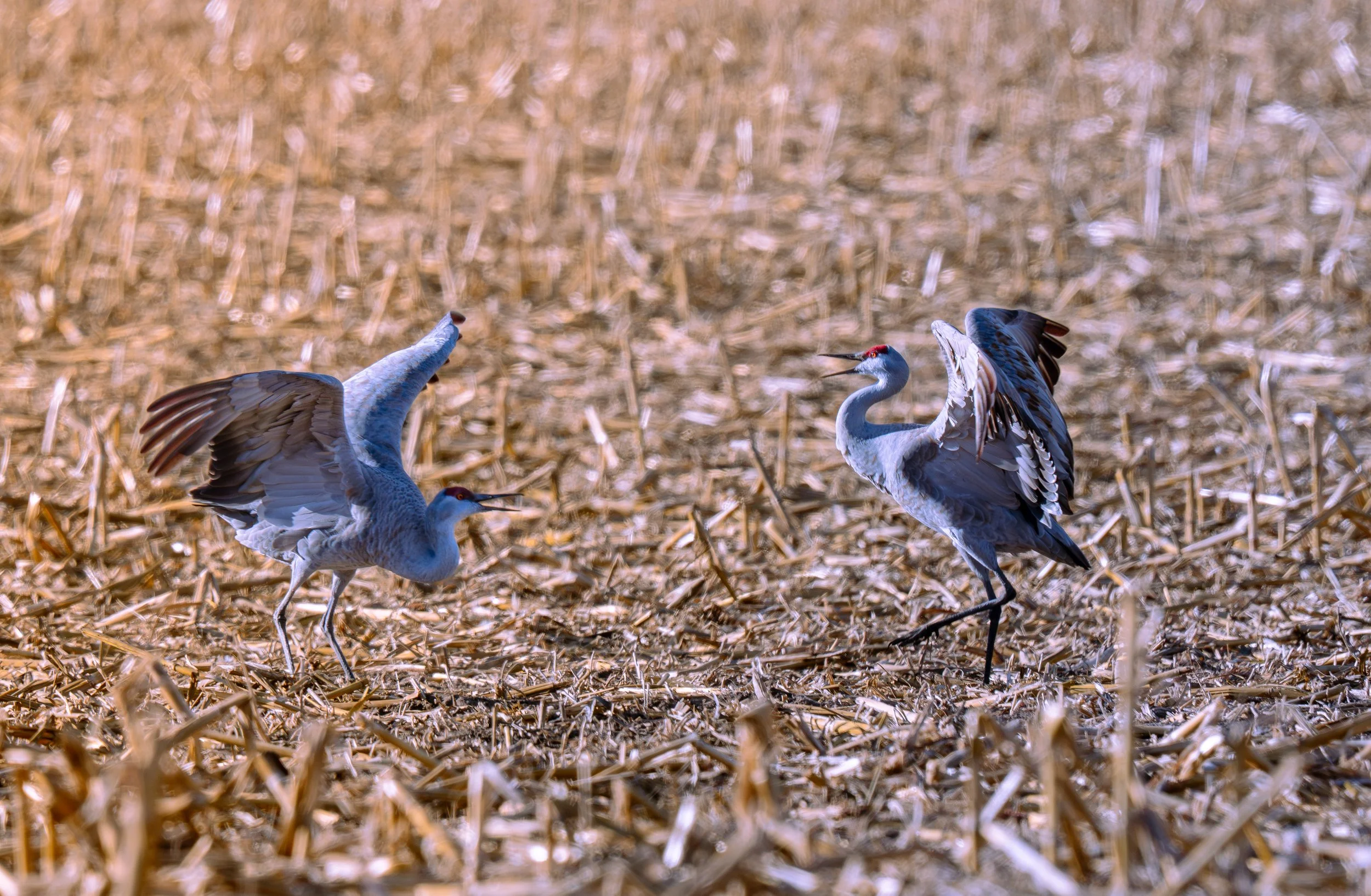
Welcome to the Dance
As the sun rose over the river, thousands of cranes stirred from their night’s sleep. They began taking to the sky in groups of tens and hundreds. I was able to take some spectacular photos and video of these beautiful birds in flight.
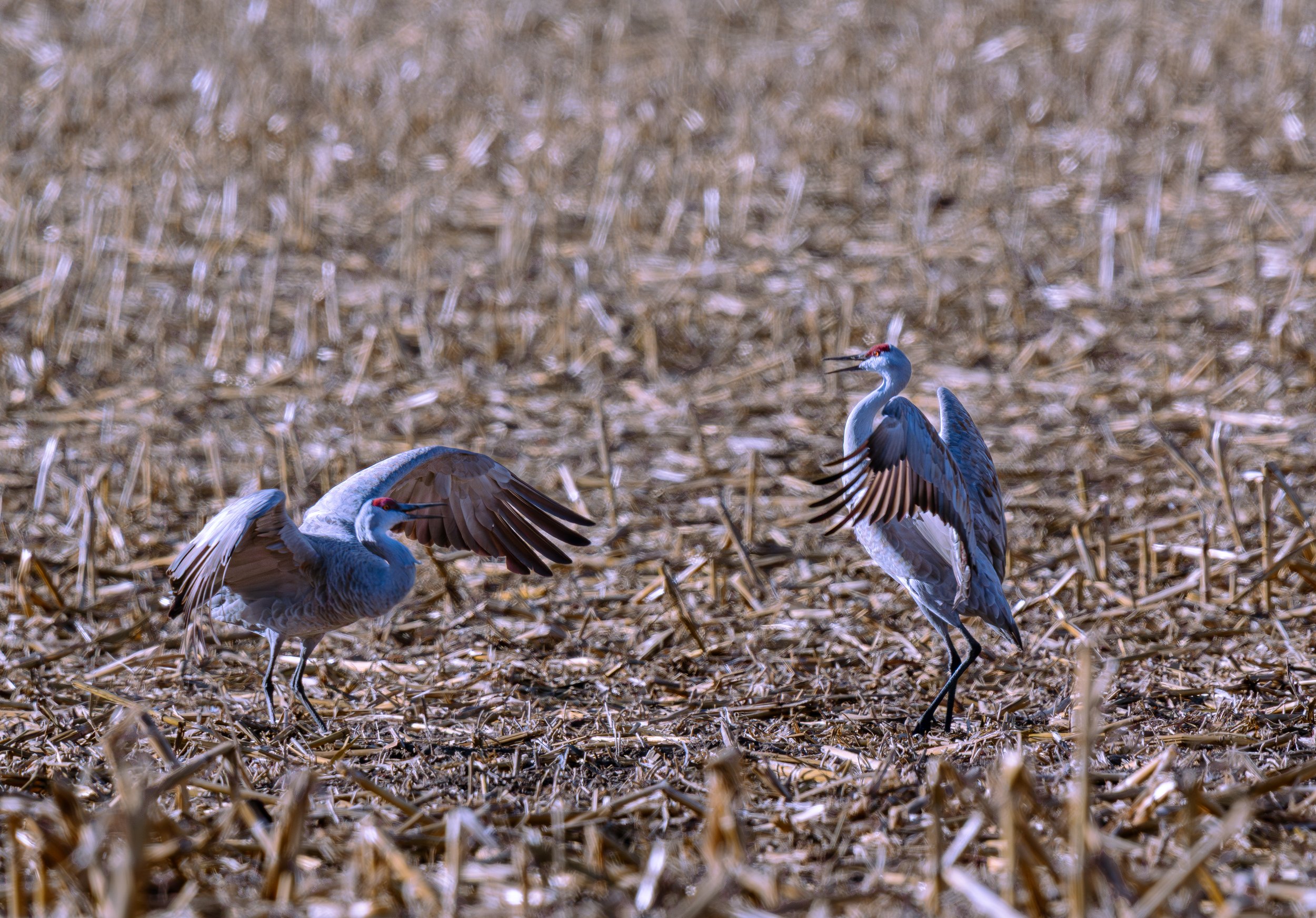
Behind the Camera
Last March, I had the opportunity to visit Kearney, Nebraska. This wasn’t my first time in Kearney, but this trip was for a different purpose. Nearly forty years ago, I traveled to Kearney, as well as the neighboring towns of Grand Island and North Platte. Then I was still on active duty and the Army was looking for property to build Army Reserve facilities there. That was a much younger me.
Now, I was in Kearney to see one of nature’s great wonders – the Great Migration of Sandhill Cranes. Every year, nearly one million cranes leave their winter homes in southern Texas and Mexico. They fly two to five hundred miles a day toward their cooler summer nesting in Alaska, Canada, and some even go to Siberia. They have flown the same route for centuries.
In March, Sandhill Cranes stop along the Platte River in Nebraska. There they rest and eat to prepare for the remainder of their journey. The experts at the Crane Trust Nature & Visitor Center in Wood River, Nebraska, told us that the cranes would add twenty percent to their body weight during their layover. The Crane Trust folks were wonderful, and I took advantage of an early visit to their observation blinds along the river. It was awesome!
As the sun rose over the river, thousands of cranes stirred from their night’s sleep. They began taking to the sky in groups of tens and hundreds. I was able to take some spectacular photos and video of these beautiful birds in flight.
After a couple of hours in the blinds, the morning sun fully lit up the sky and the last of the roosting birds flew out to nearby corn fields for a hearty breakfast. I also left and drove to some of the surrounding farms to get a different glimpse of these birds.
Our Crane Trust guide told us about a courting ritual of the Sandhill Cranes. It’s a dance between prospective pairs of cranes. Crane, like geese and eagles, mate for life. So, there they spend time getting to know one another. It seems that the male crane tries to show off to the females by jumping into the air. They will jump higher and higher to impress the object of their affection. If the female approves of the male’s efforts, she will spread her wings and bow, as if to say, “That’s nice, but you can do better.” The male will then continue to jump, and the female bows in approval.
I saw this dancing when the birds were in the river, but the couple in this photograph were the stars of the dance contest. While all the other birds were busy eating their fill, these two were dancing to their hearts content. It was beautiful and mesmerizing to watch. So, I call this photograph, “Welcome to the Dance.”
Geek Speak
While this appears to be a simple composition, it was challenging to take a sharp photo. Using my Sony a6700 camera and Sony 200-600mm lens. The birds were in this corn field. Using the full focal length of 600mm, I zoomed in on this pair of cranes. The shutter speed was 1/640 seconds. I’ve learned when I hand hold a zoom lens, I must compensate for my hands shaking by setting my shutter to about 1/100 second for every 100mm of zoom. Using a tripod allows me to slow the speed much more.
I wanted a good depth of field to keep everything a clear as possible, so my aperture was set to f/9. The early morning light required my ISO to be 320. I often use auto-ISO when photographing wildlife. My camera can make that adjustment much faster than me. So, using manual mode for shutter speed and aperture, I can freeze the motions and create the depth of field as broad or narrow as I wish for the composition.
That sounds fairly simple, so what was so challenging? Trying to get the proper focus was problematic. My camera has awesome autofocus with AI supported eye detect for whatever subject I am photographing. However, I usually use the zone focus setting on my camera’s sensor. So, my camera kept focusing on the ground, the corn, the other birds, and missing the subjects that I was trying to capture. So, I changed my focus setting to spot focus. That gave me a small box in the center of my view finder. Setting the subject of my interest in that box and my autofocus on bird detection, the focus snapped immediately onto the eye of the bird in my view finder. With the aperture at f/9, both birds were in focus and I could take this sharp image. Another lesson learned as I continue to be schooled by the beauties of nature.
This photo is available for purchase from the store page of this website. Check it out with many other wildlife and nature photographs. Also, be sure to check out the full video on this adventure and subscribe to my YouTube channel. It’s free, and it allows me to share more exciting adventures. Here’s a link - https://youtu.be/cIMBU2heMAs?si=aJ0in6KnGPWB6JUo

Happy 249th Birthday, America!
On July 4, 2025 we celebrated America’s 249th birthday! Well, technically 249 years of the United States’ independence. I never want to arrogantly diminish the heritage of my Canadian or Mexican friends. Their histories are filled with heroic figures (and scoundrels), just like the United States.

Taken at Elk City Kansas, 2025
Behind the Camera
On July 4, 2025 we celebrated America’s 249th birthday! Well, technically 249 years of the United States’ independence. I never want to arrogantly diminish the heritage of my Canadian or Mexican friends. Their histories are filled with heroic figures (and scoundrels), just like the United States. Still, we celebrate our birth as a republic and the monumental place that we have on the world’s stage. Not without challenges, not always pretty, but the world would certainly be poorer without us.
I look back on my family with a fulness of spirit, and a head held slightly higher as I think of my ancestors. My grandfather served as a Soldier in the trenches of World War I. Called the “Great War” and the “War to end all Wars.” Of all people, my family knows that no war is great, and if that global conflict was fought to end all wars, well…it was an unfortunate failure. It only begat more war.
My father endured the Great Depression and joined the United States Navy during the Second World War. He was severely injured in the South Pacific as he served on the U.S.S. Enterprise. Dad never talked about combat. Like so from of that “Greatest Generation” he only told the funny stories. In fact, I never knew he had been injured until I looked up his records in the National Archives. Among the many things that Dad passed on to his sons (I am the youngest of six boys, and no sisters), his work ethic is what may be the easiest to observe. However, he was also meek, generous, and loved America. We all do too.
My older brothers reflect Dad’s commitment to serve others. The three eldest all served in Southeast Asia. Another conflict so very far away. Each tasting a different branch of the military; Air Force, Army, and Marine Corps, respectively. Another brother joined the Air Force, and the fifth brother followed a higher calling of service and entered the ministry.
I was uncertain of where I would serve. Initially, enlisting in the Air Force. I had the opportunity to switch to the Army, attend Officer Candidate School, and serve the remainder of my career as an Army Officer. I was fortunate to serve with the most amazing and talented people I have ever known.
From a poor high school student to serving as a senior officer in the Pentagon, I was very blessed. No other nation offers such an opportunity. I credit the first sergeant who saw something that I failed to see in myself. He kicked me in the rear (literally) and sent me to various educational courses. He challenged me to give my all at these programs. What I learned about myself is that I loved to learn. I still do.
Perhaps studying photography after completing two other careers is the result of my Dad’s insatiable curiosity and first sergeant’s tenacity for me to do better. Whatever it is, I owe a debt to those who invested in my life. I owe a debt to a Nation that gave me a chance to break out of my limits and strive for more.
This is an amazing Nation. Not perfect, but better than any other place I have ever been. God bless America!
Geek Speak
I took this photo at the Independence Day celebration in Elk City, Kansas. Elk City has a population of less than 250 (that’s right, 250 people), but they put on a fireworks display unequaled in the area.
This photo was taken with a Sony a6700 camera and Viltrox 27mm, f/1.2 lens. The bright lights from the fireworks could blow out the image if normal night settings were used. So, I set the shutter speed to 1/100 and the aperture to f/9. Yep, those are typically daytime landscape setting. The ISO was set at 3200 and the White Balance was at 3800 Kelvin. Those are my go-to night settings. (TIP: All these settings are what I use for nighttime lightning photographs. However, I use a timelapse for lightning because it is so unpredictable).
I would love to hear how you take photos of fireworks, lightning, or other high contrast images.
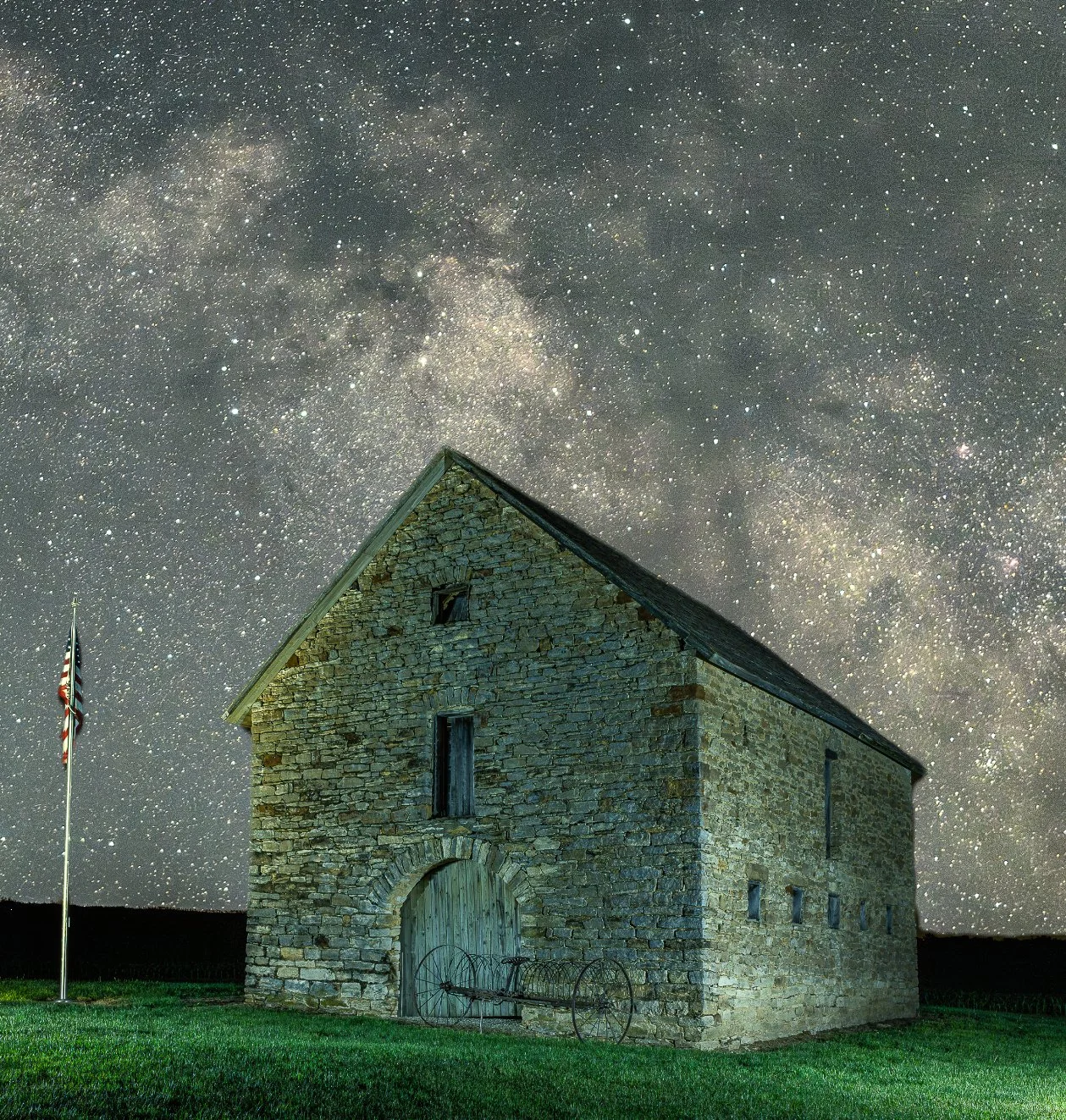
The John Dickenson Barn
During the early 1850’s, America was drawing battle lines within itself. Civil unrest swelled toward civil war. New land was opening in Kansas territory. John and Lavina Dickenson moved from Lee County, Virginia to this place near Robinson in east Kansas.
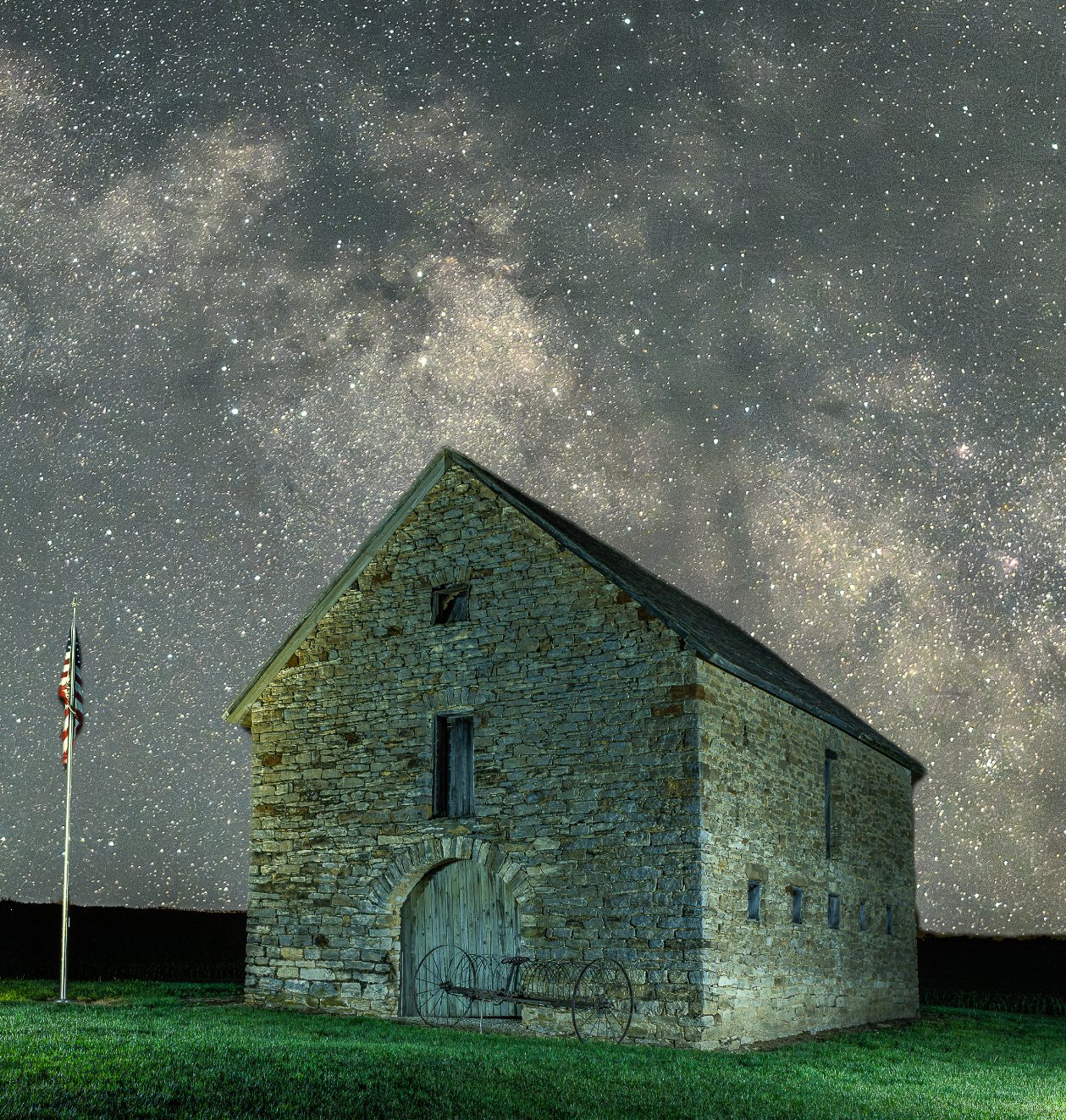
The Story Behind the Camera
During the early 1850’s, America was drawing battle lines within itself. Civil unrest swelled toward civil war. New land was opening in Kansas territory. John and Lavina Dickenson moved from Lee County, Virginia to this place near Robinson in east Kansas. Land was being offered for a dollar an acre and each family was allowed a thousand acres of land, most of which was covered in prairie grass.
The Dickenson family traveled into Kansas by oxen and wagon. They built a sod house across from this old stone barn. They taught school in the winter at a prairie school to pay for the land. John and his older sons decided to plant wheat and oats. They would need a place to store the grain and hay for the cattle. They built a stone barn.
The father and sons hauled river rock by wagon from near Atchinson. They put the rock together with mortar. The walls are two-feet thick, and the wood beams came for the limited nearby timber. Trees were hand hewed and put together with wooden pegs. The lower level was used for horses and mules. The second level was for grain and hay, and the third level was for corn that would be used as seed for the next year. Ventilation openings were used in the bins where the grain was stored.
John and Lavina lived here for the rest of their lives. They were buried in the Robinson Cemetery. The farm was passed down to their descendants until 1979. The barn still stands as a monument of the work of John Dickenson and his sons. Construction began in 1852 and was completed in 1861, the year of Kansas’ statehood.
Since 1979, the Tietjens’ family has owned the farm. They restored this barn to honor its history. In 1981, a new roof replaced the damage from a tornado in late 1980. Today, this beautiful historic barn attracts the interest of photographers, artists, travelers, and lovers of the history of frontier life on the Plains.
Geek Speak
This proved to be a challenging photograph. Clear weather had been forecasted. However, smoke from Canadian wildfires filled the upper atmosphere. Stars were barely visible through the haze in the sky. Still, I drove 4 hours to the site of this old barn.
Preparing for a single exposure, I setup the tripod along the northwest corner of the property. The tripod legs were spread out to create a near flat, but stable platform. This permitted a high angle composition to capture as much sky as possible.
With a Viltrox 27mm, f/1.2 prime lens mounted to my Sony a6700 camera, the settings included a 15 second shutter speed, aperture f/5.6, and ISO 800. The increased shutter speed was to permit as much light to come through the smoky sky as possible. The long shutter speed risked stars to be distorted by the earth’s rotation. However, I decided to take that risk. I had to tighten the aperture and decrease the ISO to prevent the highlights from blowing out the image.
With these camera settings, I took several photos from the same camera position. This allowed me to “light paint” the barn from each side. It also took advantage of the ever-changing atmospheric smoke to attempt to get the best exposure of the stars. In the end, I was satisfied with the results. Like many other places, I hope to return to the Dickenson Barn on a clear night and get more photos of this historic icon of Kansas agriculture.

Historic Oak Grove Schoolhouse
In 1877, the Oak Grove School was built from native sandstone, quarried a short distance from the school site. This one-room schoolhouse serve as a school, a church, and as a local community gathering place for the residents of rural Lincoln Township up until the early 1960’s when school unification closed nearly all one-room schools across Kansas and most of the United States.

Historic Oak Grove Schoolhouse
The story behind the camera.
In 1877, the Oak Grove School was built from native sandstone, quarried a short distance from the school site. This one-room schoolhouse serve as a school, a church, and as a local community gathering place for the residents of rural Lincoln Township up until the early 1960’s when school unification closed nearly all one-room schools across Kansas and most of the United States.
The Osage Trail was a series of trails across this territory where the Osage Indian Tribe lived, hunted, and honored their ancestors. The main trail passed directly in front of the Oak Grove School, intersecting the Continental Trail about one-half mile south of here. Settlers, like the Laura Ingalls family, followed this route, past Ladore (north of Parsons), the infamous Bender’s Inn, Independence, KS, and many other historic landmarks along their journeys. Those who settled here in the early 1800’s, lived in peace among the Osage people, who trusted and respected Jesuit Priests at Osage Mission (St. Paul, KS), enough to have their children educated by the Jesuits.
With support from the Pruitt family, community organizations, and a growing number of area residents, Oak Grove School has been faithfully restored to reflect nearly 150 years of rich local history. Future plans include a pavilion situated to the south of the school which will feature modern restrooms and the original school bell. Due to structural concerns, the bell housing was removed many years ago.
This information was reprinted from the brochure available at the Oak Grove School.
Geek Speak
This was one of the most challenging photos of this year’s collection. There was a bright moon competing with the Milky Way and nearly washing out the starry sky. A street light on the west side of the property also made it hard to capture a good image of the scene. Area alarms sounded as I tried to get near the schoolhouse to lightpaint the area. Still, I managed to take this photograph. Let me tell you how I did it.
I sat my camera on a tripod along the gravel road along the northside of the building. I used mmy Sony a6700 camera and Viltrox 27mm, f/1.2 lens. The lens was fitted with an artificial light filter. I sat the camera shutter speed at 8 seconds, an aperture of f/2.2, white balance set at 3800 kelvin, and ISO at 3200, I took a panorama of two images wide and two images tall.